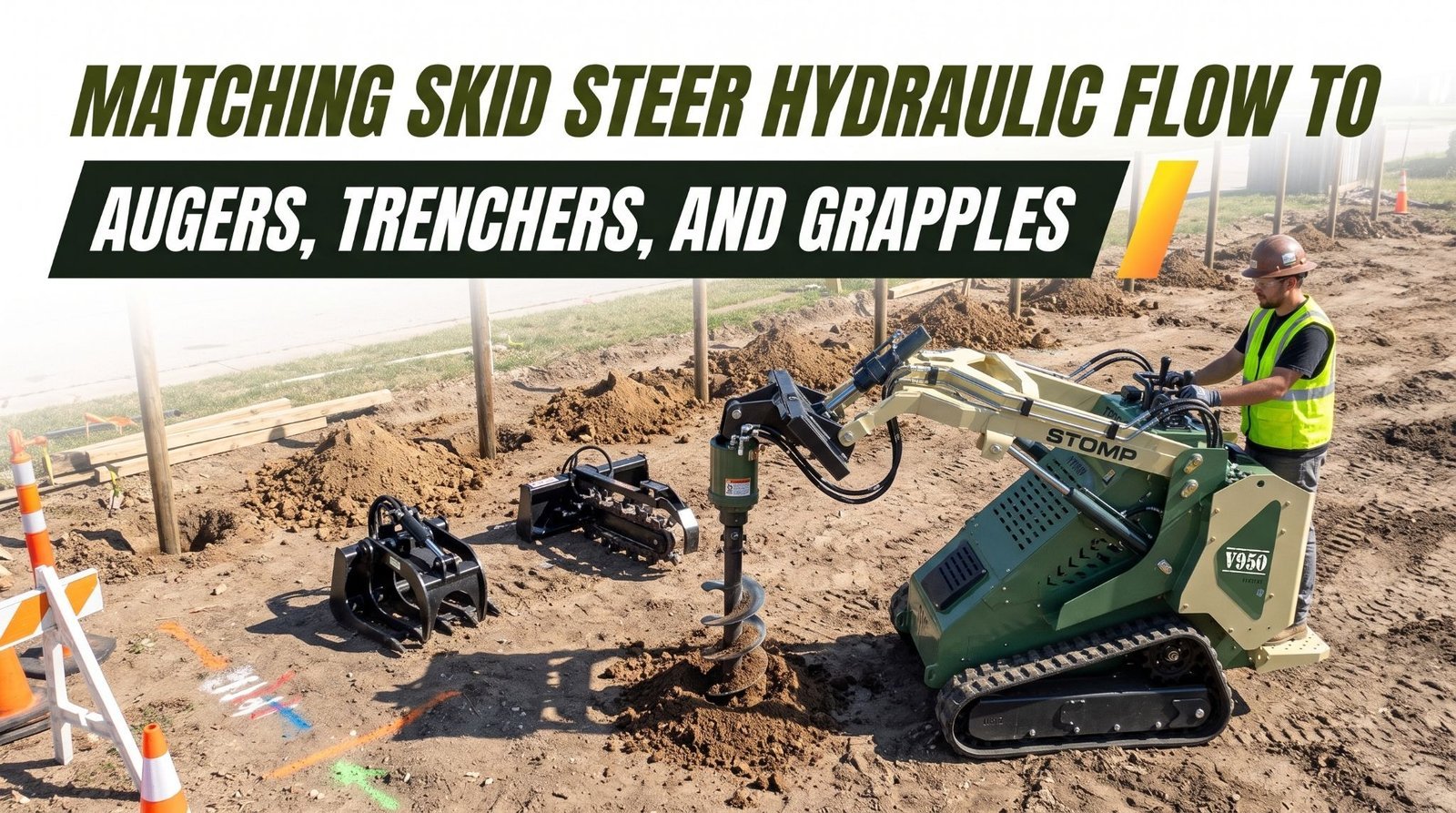
Matching Skid Steer Hydraulic Flow to Augers, Trenchers, and Grapples
Matching Skid Steer Hydraulic Flow to Augers, Trenchers, and Grapples
A skid steer becomes far more capable once you connect a hydraulic attachment. An auger bores post holes and footings. A trencher cuts clean channels for irrigation, drainage, and utility lines. A grapple grips brush, logs, rock, and demolition debris that a standard bucket cannot hold. With the right attachments, one machine can cover a wide range of jobs on construction sites, farms, landscaping projects, and property maintenance work.
Every one of these attachments depends on the loader’s auxiliary hydraulic system for power. The loader’s pump sends pressurized fluid through hoses and couplers to the attachment. That fluid drives a motor or moves a cylinder, then returns to the loader’s reservoir. When the loader and attachment are well matched, the attachment runs at its intended speed, delivers its designed force, and stays within safe operating temperatures.
When they are poorly matched, problems follow quickly. An auger may turn too slowly to drill efficiently. A trencher chain may stall in firm soil or run faster than its components are designed to handle. A grapple may close sluggishly or clamp with more force than the material or attachment can tolerate. Mismatched systems can also overheat hydraulic fluid, damage motor seals, wear components early, and create unsafe operating conditions for the operator and nearby workers.
Understanding Hydraulic Flow
Hydraulic flow is the volume of fluid the loader’s auxiliary system delivers to an attachment over time. In the United States, it is commonly measured in gallons per minute (GPM). Flow controls speed. The more fluid that reaches a hydraulic motor, the faster it turns. The more fluid that reaches a cylinder, the faster it extends or retracts.
These ranges are general examples only. Always confirm the exact flow figures for the specific loader in the operator’s manual or on the specification sheet, since two machines of similar size can deliver very different flow.
Each attachment is designed to work within a specified flow range. Too little flow causes slow operation, reduced productivity, and in some cases stalling. Too much flow can drive a motor faster than it is designed to turn, cause jerky or hard-to-control movements, and force excess fluid across relief valves. That excess fluid turns into heat, which breaks down hydraulic oil, hardens seals, and shortens component life in both the attachment and the loader.
More flow is not automatically better. The right flow is the flow the attachment’s manufacturer specifies for the job.
Key takeaway: Hydraulic flow, measured in GPM, controls how fast attachment motors and cylinders operate, so confirm the loader’s actual flow and match it to the attachment’s specified range rather than assuming more flow means better performance.
Pressure Requirements
If flow controls speed, pressure controls force. Hydraulic pressure is the resistance the fluid works against as it pushes on a motor or cylinder. It is measured in pounds per square inch (PSI). The higher the pressure the system can generate, the more torque a motor can produce and the more force a cylinder can apply.
Pressure in a hydraulic system builds in response to load. When an auger bit meets hard clay, when a trencher chain cuts through compacted soil, or when grapple jaws close around a heavy log, the resistance increases and system pressure rises. The loader’s relief valve sets the maximum pressure the auxiliary circuit can reach. Once that limit is reached, the relief valve opens to protect the system, and the attachment slows or stops.
Attachment requirements vary according to motor design, cylinder size, and the task. A small grapple cylinder needs much less flow to move than a large trencher motor, but both depend on adequate pressure to do their work. Hoses, couplers, and fittings in the circuit must also be rated for the pressure they will carry.
Pressure carries serious safety implications. Fluid escaping from a pinhole leak or damaged hose under pressure can penetrate the skin, even when the leak is too small to see. A fluid injection injury may look minor at first but requires immediate medical attention. Never use your hand to search for a leak. Use a piece of cardboard or wood instead, and wear gloves and safety glasses when inspecting hydraulic components.
Key takeaway: Hydraulic pressure, measured in PSI, provides the force behind every attachment, so confirm the loader supplies enough pressure for the attachment without exceeding the attachment’s maximum rating, and never check for leaks with bare hands.
Hydraulic Flow for Trenchers
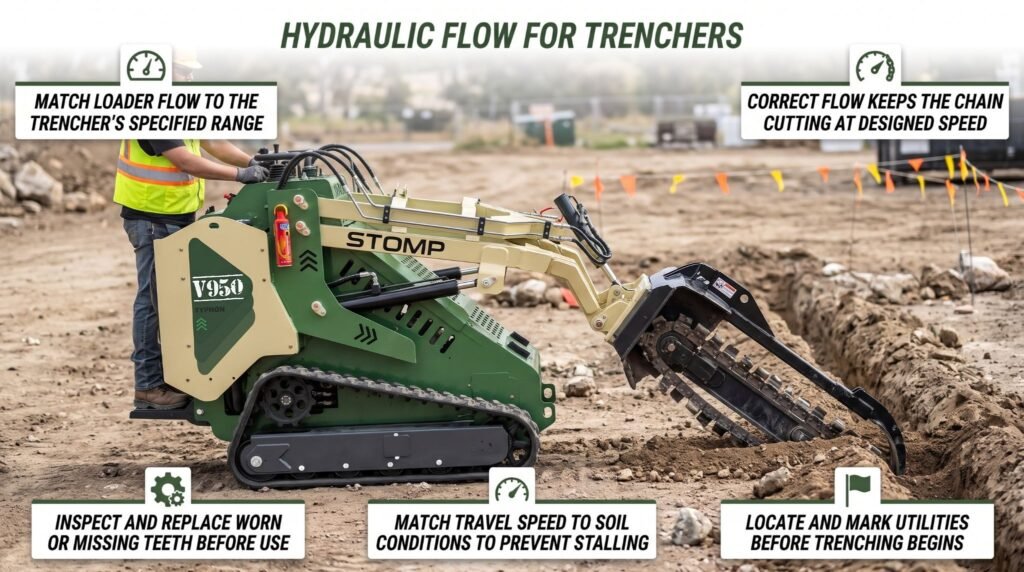
Trenchers are among the most hydraulically demanding attachments a skid steer can run. They use a hydraulic motor to drive a digging chain fitted with teeth around a boom. As the chain turns, the teeth cut soil and carry it out of the trench, where an auger or spoil deflector moves it to the side.
Matching the auxiliary circuit to the trencher’s requirements supports appropriate chain speed and cutting performance. Flow determines how fast the chain moves. Pressure determines how much force the motor can apply before the chain slows or stalls in hard ground.
Getting flow right has a direct effect on results:
- Insufficient flow: The chain turns slowly, cutting rate drops, and the operator may be tempted to travel faster than the chain can cut. The result is stalling, uneven trench depth, and lost productivity.
- Correct flow: The chain runs at its designed speed, cuts cleanly, and carries spoil out of the trench efficiently.
- Excessive flow: The chain may run faster than the trencher is designed to handle, accelerating wear on teeth, sprockets, and chain components, and generating excess heat in the hydraulic system.
Many larger trenchers are designed specifically for high-flow circuits. Connecting a high-flow trencher to a standard-flow loader usually produces slow, frustrating performance. Connecting a standard-flow trencher to a high-flow circuit can exceed the attachment’s limits unless the manufacturer specifically permits that configuration.
Trenchers also carry significant safety risks. The moving chain can cause severe injuries and throw soil, rocks, and debris. Keep workers well outside the trencher’s operating area, and never step over or reach toward the chain while it can move. Complete utility locating before trenching, and expose marked lines using approved methods before mechanized digging continues near them.
Before clearing debris, adjusting chain tension, or replacing teeth, stop the chain, lower the attachment, shut down the loader, remove the key, and relieve hydraulic pressure according to the manufacturer’s procedure.
Key takeaway: Match the loader’s auxiliary circuit to the trencher’s flow and pressure requirements to support proper chain speed, account for soil hardness, depth, chain condition, and tooth wear, and always stop the chain and shut down the loader before servicing.
Matching Augers to the Loader
Augers are among the most popular skid steer attachments. They drill holes for fence posts, deck footings, tree planting, signposts, foundation piers, and soil sampling. An auger uses hydraulic power to rotate a drilling bit through soil, usually through a hydraulic motor connected to a gearbox or drive unit that multiplies torque before it reaches the bit.
Flow and pressure each shape auger performance in their own way. Flow mainly determines rotation speed. Pressure, working through the drive’s gearing, determines how much torque the bit can deliver before the system reaches its relief setting. A loader that supplies insufficient flow may operate slowly, extending drilling time on every hole. Unsuitable pressure can affect torque and system performance, causing the bit to stall in firm ground or overstress the drive.
Excessive flow can be just as problematic. An auger spinning too fast in hard ground may bounce, walk off the marked location, or wear teeth and flighting quickly. In heavy soils, a slower, high-torque setup often drills more effectively than a fast-spinning bit.
Never guide, steady, or clean an auger by hand while it can rotate. Stop rotation, lower the auger, shut down the loader, and remove the key before clearing soil or inspecting the bit.
Key takeaway: Match the auger drive’s flow and pressure range to the loader, account for bit diameter and ground conditions when estimating torque needs, locate utilities before drilling, and never approach a rotating auger.
Grapple Operation and Control
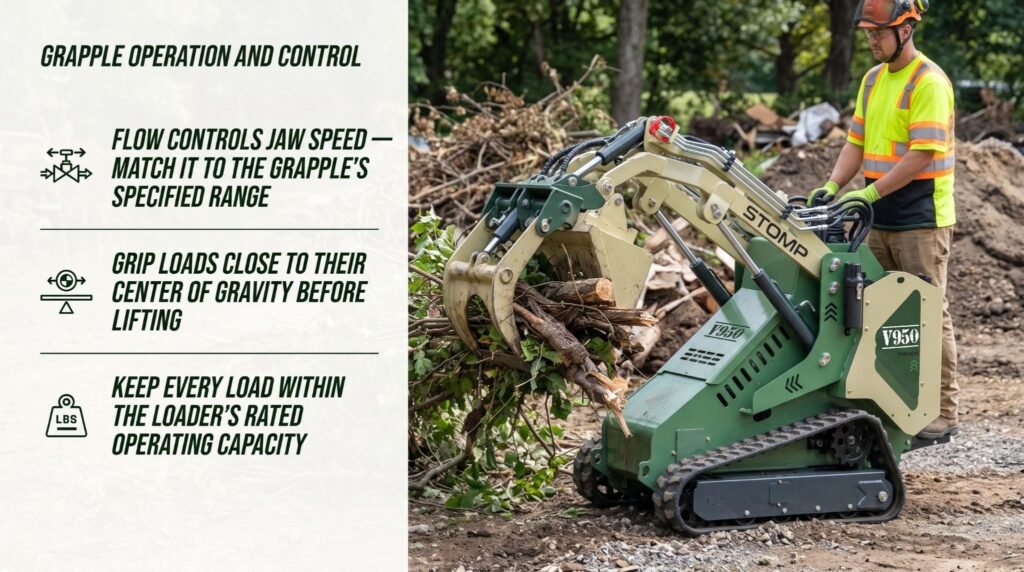
Grapples turn a skid steer into a versatile material handler. They grip brush, logs, rock, scrap, demolition debris, round bales, and other loads that are awkward or impossible to carry in a standard bucket. Most grapples use one or more hydraulic cylinders to open and close the jaws or clamps.
Grapple loads also bring stability considerations. Logs, rock, and debris are often irregular, unevenly weighted, and heavier than they appear. Keep every load within the loader’s rated operating capacity, including the weight of the grapple itself. Grip loads close to their center of gravity where possible, and avoid carrying long items that extend far beyond the sides of the machine.
Never use a grapple to lift people, and never allow anyone to stand under or beside a suspended load. If a load shifts or begins to slip, lower it to the ground in a controlled manner and reposition the grip.
Key takeaway: Grapple flow controls jaw speed while pressure controls clamping force, so use smooth, controlled movements, avoid excessive force that can damage material or the attachment, and keep every load within the loader’s rated operating capacity.
Checking Compatibility Before Use
Most hydraulic attachment problems can be prevented before the attachment ever runs. A few minutes spent confirming compatibility protects the loader, the attachment, and the operator, and it prevents the downtime that follows a damaged motor, blown seal, or overheated system.
Connect hoses according to the manufacturer’s procedure. In most cases, this means lowering the attachment to the ground, shutting off the engine, and relieving pressure in the auxiliary circuit using the loader’s approved method before connecting or disconnecting couplers. Trapped pressure can make couplers difficult to connect, cause them to release fluid unexpectedly, or damage coupler seals.
If the attachment does not perform as expected, stop and investigate before continuing. Common causes include incorrect circuit selection, a coupler that is not fully engaged, a missing case-drain connection, or a mismatch between loader output and attachment requirements.
Key takeaway: Compare the attachment manual and loader specifications for flow range, pressure limits, connection type, return and case-drain needs, and capacity, inspect hoses and couplers before connecting, relieve pressure using the approved method, and test the attachment in a clear area before work begins.
Conclusion
Matching hydraulic flow and pressure to the attachment is essential for dependable skid steer operation. Flow sets the speed of motors and cylinders, while pressure provides the force behind every rotation, cut, and grip. Augers need the right combination of flow and torque for their bit diameter and the ground conditions they face. Trenchers depend on suitable flow to keep the chain cutting at its designed speed, supported by sharp teeth, correct chain tension, and a travel speed matched to the soil. Grapples rely on controlled flow for smooth jaw movement and appropriate pressure for secure clamping without damaging the load or the attachment.
Consistent inspections help identify hydraulic leaks, worn couplers, damaged hoses, and loose connections before they affect performance. Confirming compatibility before use brings these factors together, from flow range and pressure limits to coupler type, return requirements, and case-drain connections. Careful inspection, proper pressure relief, and a test run in a clear area complete the process. When you confirm compatibility before every connection and operate within the limits of both machines, you protect the loader and attachment while getting reliable digging, trenching, and gripping performance on every job.
FAQs
Can an attachment operate on any skid steer?
No. It must match the loader’s hydraulic flow, pressure, connections, and capacity requirements. An attachment designed for high flow may run poorly on a standard-flow loader, while a loader with excessive flow or pressure can damage an attachment that is not rated for it. Coupler type, return and case-drain requirements, mounting system, and rated operating capacity must also be compatible. Always compare the attachment manual with the loader specifications before connecting.
Does higher hydraulic flow always improve performance?
No. Excessive flow can exceed attachment limits or cause unsuitable operating speed and heat. Each attachment is designed for a specific flow range. Too much flow can over-speed motors, make movements jerky and hard to control, and force excess fluid across relief valves, generating heat that breaks down oil and damages seals. Use the flow the attachment manufacturer specifies.
Why does a trencher run slowly?
Possible causes include insufficient flow, unsuitable operating conditions, worn components, or hydraulic system problems. A standard-flow loader running a trencher designed for high flow is a common cause. Hard or rocky soil, excessive trench depth, dull or missing teeth, a stretched chain, overheated hydraulic fluid, a coupler that is not fully engaged, or a missing case-drain connection can also reduce chain speed. Stop the chain, shut down the loader, and inspect before continuing.
Should hydraulic couplers be connected under pressure?
Follow the manufacturer’s procedure. Relieve trapped pressure using approved methods before connecting or disconnecting. In most cases, this involves lowering the attachment to the ground, shutting off the engine, and using the loader’s pressure-relief function. Connecting under pressure can make couplers hard to engage, damage seals, and release fluid unexpectedly. Clean both coupler halves before connecting, and use a piece of cardboard rather than your hand to check for leaks afterward.


