
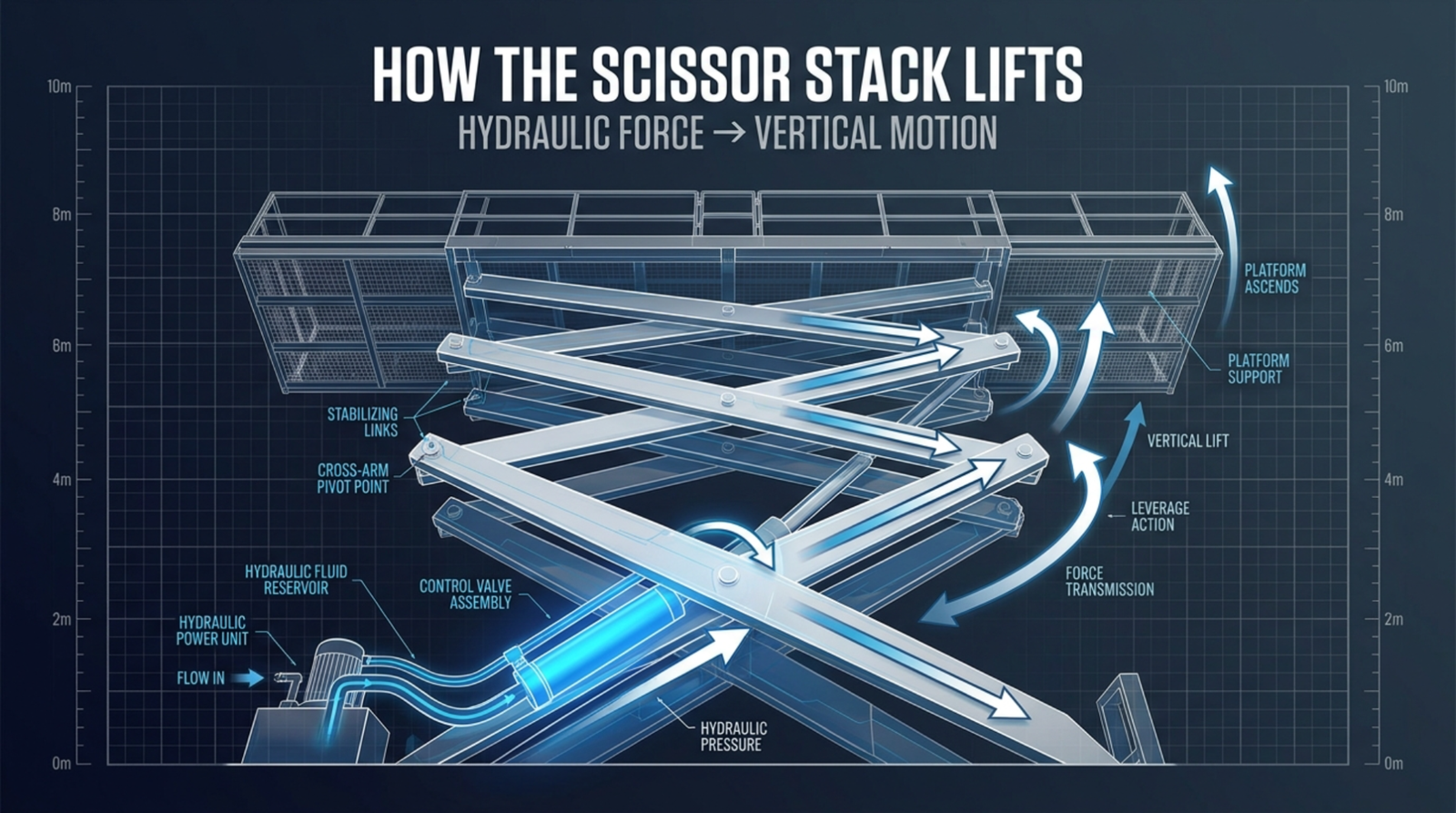
A scissor lift does not push the platform straight up
How the Scissor Lift Stack Supports Vertical Lifting
The scissor lift stack is the heart of every scissor lift, turning a simple hydraulic push into steady, controlled vertical movement. Understanding how the scissor stack supports vertical lifting helps operators work more safely and get the most from their equipment. This linked framework of crossed arms does far more than raise a platform. It manages force, guides the load straight up, and keeps the platform stable at every height. In this guide, we break down exactly how the scissor stack works, from the way it converts hydraulic force into motion to the design choices that set its maximum lift height. Whether you run one machine or manage a fleet, knowing what happens beneath the platform gives you confidence on the job.
How the Scissor Stack Converts Force Into Vertical Movement
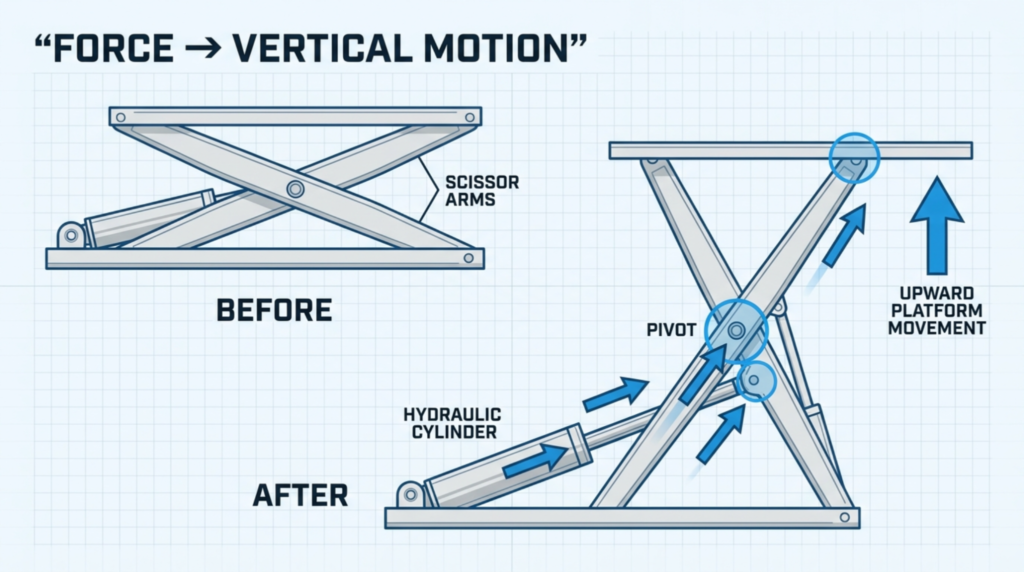
The scissor stack gets its name from its shape. It is built from pairs of arms crossed like the blades of a pair of scissors, linked together at pivot points. As the hydraulic cylinder extends or retracts, these linked arms pivot around their joints, folding and unfolding in unison. This simple, repeatable motion is what raises and lowers the platform.
Here is the key idea: the cylinder does not push the platform straight up on its own. Instead, it applies force to the scissor arms, and the geometry of those arms translates that force into vertical movement. When the cylinder extends, it pushes the crossed arms toward a more open, upright position, which lifts the platform higher. When the cylinder retracts, the arms fold back down and the platform descends in a controlled way.
This conversion of force is the mechanism’s greatest strength. A single hydraulic cylinder, often mounted horizontally or at an angle, drives a motion that carries the platform vertically. Because the arms are linked and move together, the platform rises evenly rather than tipping or lurching. The result is smooth, predictable lifting that operators can rely on across the full range of the machine’s travel.
How Scissor Arm Geometry Affects Lifting Performance
The angle and length of the scissor arms have a direct effect on how the lift performs. At different points in the lifting cycle, the geometry changes, and so does the amount of force the system needs to keep the platform moving. This is one of the most important concepts for operators to grasp, because it explains why a scissor lift behaves differently near the ground than it does higher up.
When the platform sits low, the scissor arms are more compressed and lie at a shallow, nearly flat angle. In this position, the mechanism typically requires greater force to begin raising the platform. The flat angle means the cylinder must work harder to start opening the arms, since much of its effort is directed sideways rather than upward at this stage.
As the platform rises and the arms move to a steeper angle, the geometry becomes more favorable. The force required to continue lifting generally eases because more of the cylinder’s effort now translates directly into vertical movement. Understanding this relationship helps operators appreciate why the initial lift from a fully lowered position can feel like the most demanding part of the cycle, and why arm design is carefully engineered to handle those varying loads safely.
How Hydraulic Cylinders Drive the Scissor Stack
Hydraulic cylinders are the muscle behind the scissor stack. They supply the force needed to expand the scissor arms and raise the platform, converting hydraulic pressure into the mechanical push that drives the whole mechanism. Without a properly matched cylinder, even the best-designed scissor stack cannot perform to its rated capacity.
Two factors stand out here: cylinder sizing and hydraulic pressure. The cylinder must be sized correctly for the machine, because its diameter and stroke determine how much force it can generate and how far it can drive the arms. Hydraulic pressure, meanwhile, sets how much force the cylinder produces at any moment. Together, these two elements decide whether the lift can safely support its rated platform load throughout the cycle.
This is why proper engineering matters so much. A cylinder that is too small or a system running insufficient pressure will struggle to lift heavier loads, particularly during that demanding initial rise when the arms are compressed. When the cylinder is sized correctly and supplied with the right pressure, it delivers dependable force from the ground up. Operators benefit from a machine that lifts smoothly, holds its load securely, and performs consistently on every job.
How the Scissor Stack Supports Platform Stability
Stability is where the scissor stack truly proves its value. The design uses multiple connected arms, and those arms do more than simply lift. They distribute the platform’s load through the entire lifting mechanism while keeping the platform guided vertically. This combination is what allows a scissor lift to raise a load high into the air and still feel solid underfoot.
Consider how the connected arms work together to keep the platform steady:
- Load distribution: The weight on the platform spreads across multiple crossed arms rather than resting on a single point, reducing strain and improving overall stability.
- Vertical guidance: Because the linked arms are constrained to fold and unfold in a fixed pattern, they guide the platform straight up and down rather than allowing it to sway or drift sideways.
- Even movement: All the arms move in unison, so the platform rises and lowers on a level plane throughout the cycle.
The result is a platform that stays stable as it rises and lowers. For operators working at height, this stability is not a luxury but a necessity. A well-built scissor stack gives the confidence to work productively above the ground, knowing the platform will hold steady while tasks are completed.
Why Scissor Stack Design Affects Maximum Lift Height
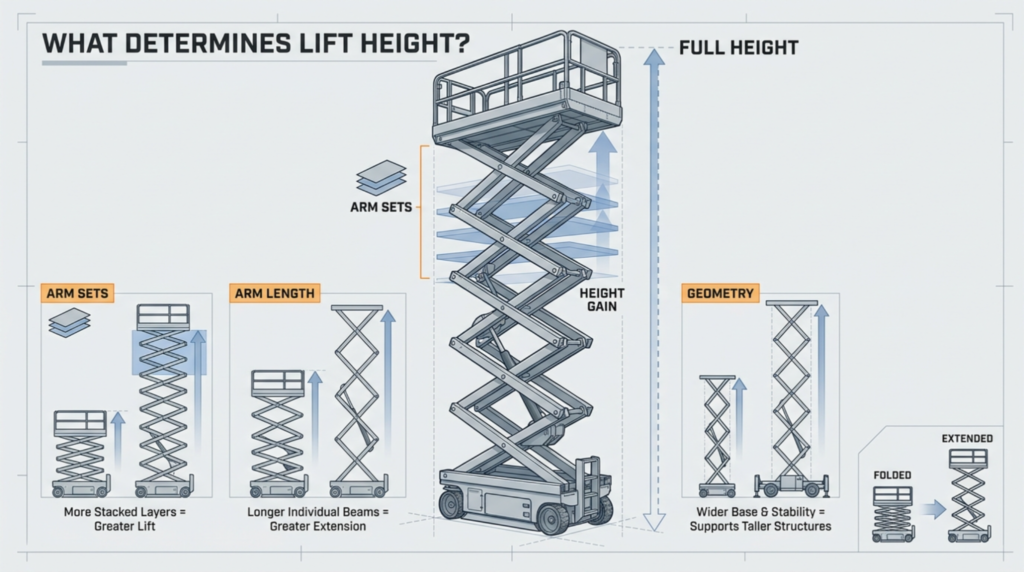
The height a scissor lift can reach comes down to the design of the stack itself. Three factors carry the most weight here: the number of scissor arm sets, the length of those arms, and their overall geometry. Each of these influences how far the platform can extend when the arms are fully opened.
Adding more sets of scissor arms is the most direct way to increase lift height. Each additional set adds another layer to the stack, so the mechanism unfolds to a greater overall height. Longer arms and favorable geometry also extend reach, allowing the platform to climb higher as the arms open. This is why taller scissor lifts feature more layers stacked one above another.
Height is never the only consideration, though. Manufacturers must carefully balance lift height against platform capacity, machine dimensions, and stability. A stack designed for extreme height must still support its rated load and remain stable at full extension, all within a footprint that keeps the machine practical to transport and operate. This balancing act is why scissor lifts come in a range of models, each engineered to deliver a specific combination of height, capacity, and stability suited to different jobs.
Conclusion
The scissor stack is a remarkable piece of engineering that quietly does the hard work on every scissor lift. By linking crossed arms to a hydraulic cylinder, it converts a horizontal push into smooth vertical movement, manages the varying force demands across the lifting cycle, and keeps the platform stable and guided from the ground to full height. Every design choice, from the number and length of the arms to the sizing of the cylinder, shapes how the machine performs, how much it can carry, and how high it can reach. For operators, understanding these fundamentals builds real confidence on the job. When you know how the scissor stack supports vertical lifting, you can operate your equipment more safely, recognize what it is designed to do, and trust it to deliver dependable performance lift after lift.
Frequently Asked Questions
1. How does the scissor stack convert hydraulic force into vertical movement?
The scissor stack is built from pairs of arms crossed like scissor blades and linked at pivot points. When the hydraulic cylinder extends or retracts, these linked arms pivot around their joints, folding and unfolding together. The cylinder does not push the platform straight up on its own. Instead, it applies force to the scissor arms, and their geometry translates that force into vertical motion. As the cylinder extends, it drives the crossed arms toward a more open, upright position, raising the platform. When it retracts, the arms fold back down and the platform descends in a controlled way. Because the arms are linked and move in unison, the platform rises evenly rather than tipping or lurching, producing the smooth, predictable lifting operators depend on.
2. Why does a scissor lift need more force near the bottom of the cycle?
The answer lies in the geometry of the scissor arms. When the platform sits low, the arms are more compressed and lie at a shallow, nearly flat angle. In this position, much of the cylinder’s effort is directed sideways rather than upward, so the mechanism requires greater force to begin raising the platform. As the platform climbs and the arms move to a steeper angle, the geometry becomes more favorable, and more of the cylinder’s effort translates directly into vertical movement. This is why the initial lift from a fully lowered position often feels like the most demanding part of the cycle. Manufacturers engineer the arms carefully to handle these varying force requirements safely across the full range of travel.
3. Why are hydraulic cylinder sizing and pressure so important?
Hydraulic cylinders supply the force that expands the scissor arms and raises the platform, so their performance is central to the whole system. Two factors matter most: cylinder sizing and hydraulic pressure. The cylinder’s diameter and stroke determine how much force it can generate and how far it can drive the arms, while hydraulic pressure sets how much force it produces at any given moment. Together, these decide whether the lift can safely support its rated platform load throughout the cycle. A cylinder that is too small or a system running insufficient pressure will struggle, especially during the demanding initial rise when the arms are compressed. Correct sizing and proper pressure deliver dependable force from the ground up, giving operators smooth, secure, and consistent lifting.
4. How does the scissor stack keep the platform stable?
Stability comes from the multiple connected arms working together. Rather than resting on a single point, the platform’s load spreads across several crossed arms, which reduces strain and improves overall stability. The linked arms are also constrained to fold and unfold in a fixed pattern, so they guide the platform straight up and down instead of letting it sway or drift sideways. Because all the arms move in unison, the platform rises and lowers on a level plane throughout the cycle. This combination of load distribution and vertical guidance keeps the platform steady as it moves. For anyone working at height, that stability is essential, giving the confidence to complete tasks productively while the platform holds firm.
5. What determines the maximum height a scissor lift can reach?
The maximum lift height depends on the design of the scissor stack, specifically the number of scissor arm sets, the length of the arms, and their overall geometry. Adding more sets of arms is the most direct way to increase height, since each set adds another layer that unfolds to a greater overall reach. Longer arms and favorable geometry also extend how high the platform can climb as the arms open. However, height is never the only factor. Manufacturers must balance lift height against platform capacity, machine dimensions, and stability. A stack built for greater height must still support its rated load and stay stable at full extension within a practical footprint. This is why scissor lifts come in various models, each tuned for a specific mix of height, capacity, and stability.


