
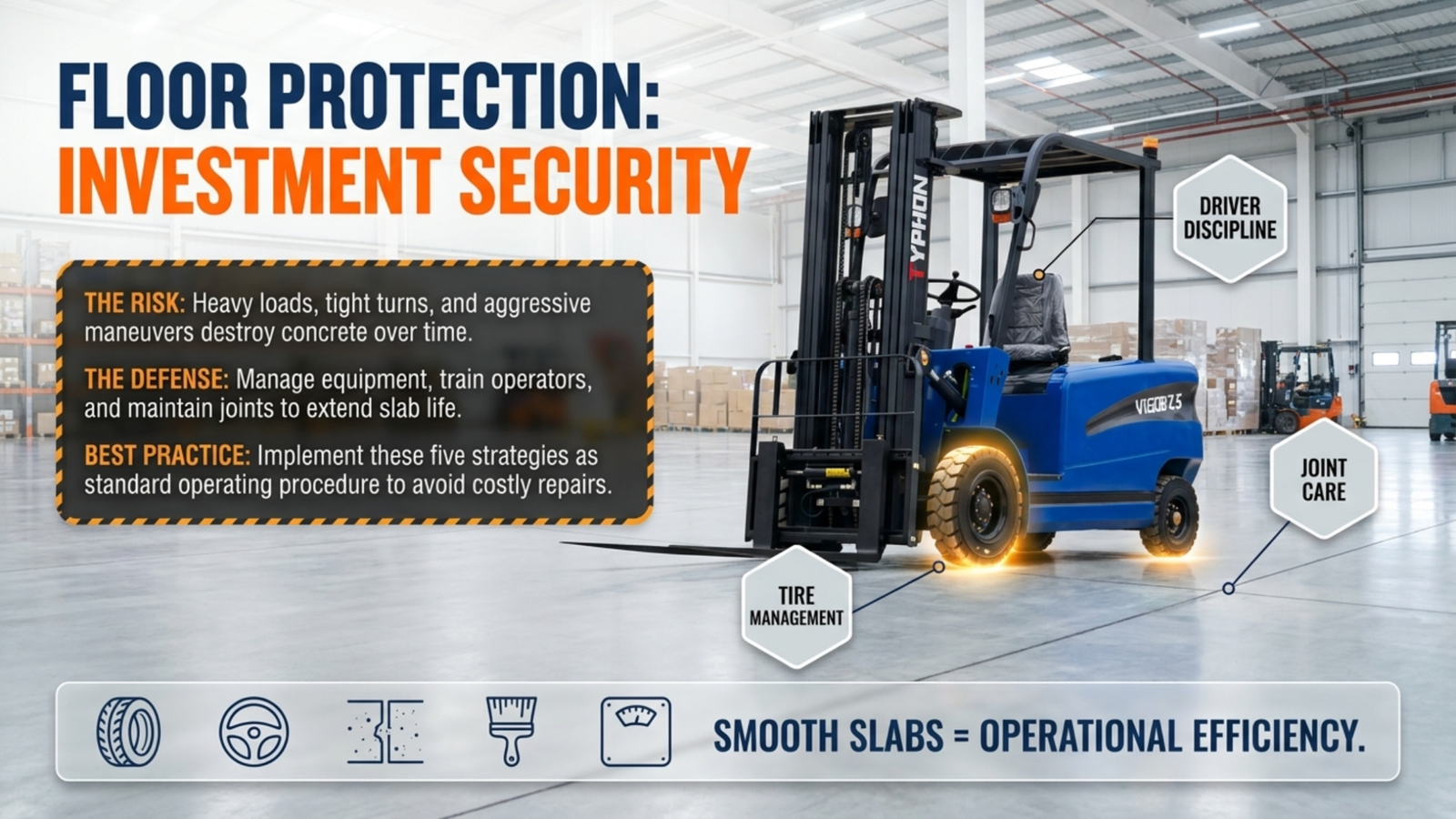
Protecting Your Warehouse Flooring from Forklift Damage
5 Proven Ways to Prevent Warehouse Flooring Forklift Damage
Warehouse floors represent a serious capital investment, often costing tens of thousands of dollars to install and far more to replace. Yet these slabs face constant punishment from the heavy loads, tight turns, and aggressive maneuvers of forklifts moving through the facility every hour of every shift. Over time, that relentless traffic takes its toll. Surface cracking, spalling, joint deterioration, and deep structural damage all creep in when a floor is left to fend for itself. The damage rarely happens overnight, which is exactly why it is so easy to ignore until repair bills arrive and operations grind to a halt. A proactive approach changes that outcome entirely. By managing the equipment, the operators, and the floor itself with a clear strategy, you can dramatically extend the working life of your concrete and protect the investment underneath your operation. The good news is that floor protection does not require a complete overhaul of how your warehouse runs. It comes down to a handful of disciplined practices applied consistently across your team. This guide walks through five proven strategies, covering tire management, driving habits, joint maintenance, protective treatments, and load handling. Each one targets a specific source of floor damage, and together they form a complete defense that keeps your slabs smooth, strong, and safe for years to come. Treat these practices as standard operating procedure rather than occasional fixes, and your floor will reward you with lower maintenance costs, fewer disruptions, and a safer environment for everyone who works on it.
Implement Proper Tire Management
Tires are the first and only point of contact between your forklift and the floor, which makes them a critical factor in how well your concrete holds up. The wrong tire, or a neglected one, transfers damaging forces directly into the slab with every pass. Choosing the correct tire type for your environment and keeping it in good condition is one of the simplest yet most effective ways to protect your investment. High-quality, non-marking tires are the standard for indoor warehouse work because they distribute weight evenly and avoid leaving the dark scuff lines that cheaper compounds drag across the surface. Matching the tire to the application keeps pressure consistent and prevents the concentrated stress that leads to gouging and surface wear.
Keep these tire management practices front and center in your maintenance routine:
- Choose non-marking tires designed for indoor use to avoid permanent black streaks on the concrete.
- Match the tire type to the surface, since the wrong compound creates uneven pressure points.
- Keep tires free of debris, as embedded rocks, metal shards, and grit grind into the floor.
- Replace worn or damaged tires promptly before flat spots and bald patches cause harm.
The reason worn tires do so much damage comes down to how pressure is distributed. A healthy tire spreads the forklift’s weight across a smooth, even contact patch. Once a tire develops flat spots, cracks, or uneven wear, that weight concentrates onto smaller areas, creating intense pressure points that gouge the surface and leave permanent marks. Debris lodged in the tread makes the problem worse, acting like a chisel dragged across the concrete with every rotation. By inspecting tires regularly, clearing out debris, and replacing them before they degrade, you keep the contact between machine and floor as gentle as the heavy work allows. This single discipline prevents a surprising amount of surface damage over the life of your equipment.
Standardize Smooth Driving Habits
Operator behavior is the single largest factor in how long a warehouse floor lasts. Even the best concrete, fitted with the right tires, deteriorates quickly under aggressive driving. The way your team accelerates, brakes, and turns determines whether the floor stays smooth for decades or starts breaking down within a few years. Standardizing smooth driving habits across every shift protects both the floor and the people working near the equipment. Enforce strict speed limits, require controlled acceleration and braking, and train operators to make wide, deliberate turns rather than sharp, scuffing pivots. These habits cost nothing to adopt, yet they remove some of the most destructive forces a floor ever faces.
Build these driving standards into your operator training and enforce them consistently:
- Set and enforce speed limits appropriate for each aisle and traffic area.
- Require smooth acceleration and braking instead of rapid starts and hard stops.
- Eliminate sharp scuffing turns that grind the tires sideways across the surface.
- Slow down near joints and ramps where the floor is most vulnerable to impact.
The damage from poor driving comes from horizontal force. When a forklift accelerates hard, brakes suddenly, or whips through a tight turn, it generates immense shearing stress that tears at the concrete surface. This force is especially destructive at joint edges, where the concrete is already weakest. A spinning, scuffing tire grinds away the surface layer and chips at the edges of control joints, accelerating the kind of crumbling that spreads across a floor over time. Rapid stops also pound the slab repeatedly with shock loads that fatigue the concrete. By holding every operator to smooth, controlled driving, you remove these violent forces from the equation. The floor seems steady, even loads instead of constant tearing and hammering, which directly extends its working life and keeps repair costs down.
Establish Regular Joint Maintenance
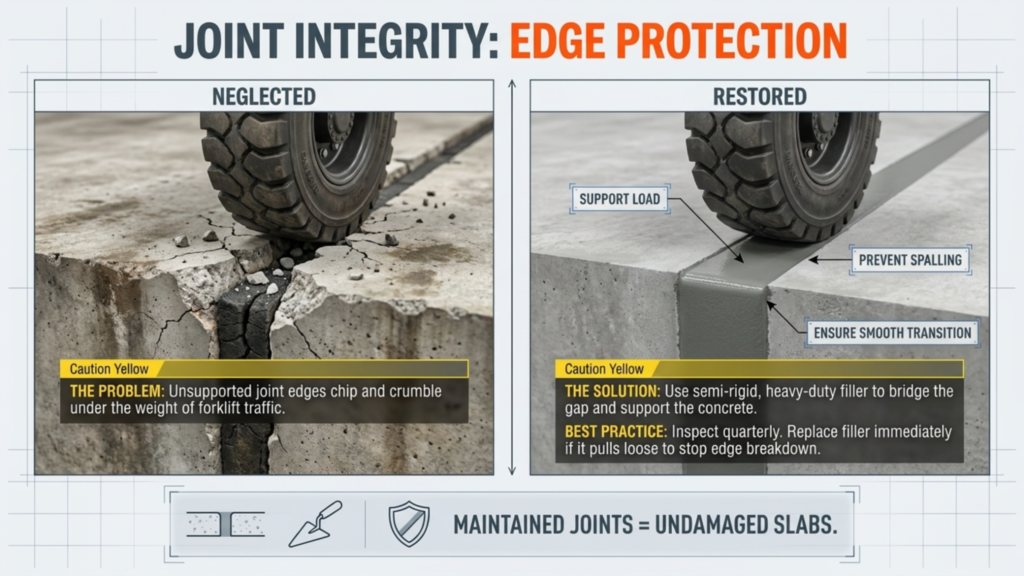
Expansion and control joints are the weakest points of any concrete floor, and they demand focused attention in any protection strategy. These joints exist for good reason, allowing the slab to expand, contract, and move without cracking randomly across the surface. But because they interrupt the continuous concrete, the edges along each joint are far more vulnerable to impact than the rest of the floor. Every time a loaded forklift wheel rolls across an open or damaged joint, it slams the unsupported edges, gradually breaking them down. Establishing a regular joint inspection and repair routine keeps these critical points intact and prevents small gaps from growing into widespread damage that undermines the entire slab.
Make joint care a scheduled part of your facility maintenance program:
- Inspect joints periodically for cracks, gaps, and missing or worn filler material.
- Repair and replace joint fillers promptly to keep edges supported under traffic.
- Use a semi-rigid filler rated for heavy forklift traffic rather than a soft sealant.
- Address spalling early before crumbling edges spread deeper into the slab.
The consequences of neglected joints escalate quickly. When a joint filler wears away or pulls loose, the edges of the concrete slab are left exposed and unsupported. Under the constant weight of passing equipment, those exposed edges begin to chip and crumble, a process called spalling. Once spalling starts, it feeds on itself. The widening gap subjects the edges to even harder impacts, the damage spreads, and what began as a minor gap turns into a rough, broken channel that jolts every forklift crossing it. Those jolts then stress the equipment and create a rougher ride that damages loads. Proper joint filler restores support to the edges, allowing wheels to roll smoothly across rather than hammering the unprotected concrete. Keeping joints filled and maintained is one of the highest-value protective measures you can take.
Utilize Floor Protection Treatments
Beyond managing equipment and operators, treating the concrete itself adds a powerful layer of defense against daily wear. Bare concrete is porous and relatively soft at the surface, which leaves it open to abrasion, dusting, and gradual breakdown under heavy traffic. Applying the right protective treatments transforms that vulnerable surface into a tougher, denser, more resilient one capable of standing up to constant forklift use. Surface hardeners, densifiers, and quality sealants all work to strengthen the concrete from the top down, closing pores and reinforcing the surface layer. These treatments are a cost-effective investment that pays off in reduced maintenance, longer floor life, and a cleaner working environment throughout the facility.
Consider how each type of treatment contributes to a stronger floor:
- Surface hardeners react with the concrete to create a denser, more abrasion-resistant top layer.
- Densifiers penetrate the slab and fill its pores, reducing dusting and strengthening the surface.
- Protective sealants form a barrier against moisture, chemicals, and surface wear.
- Combined treatments deliver a tougher, dust-proof finish built for heavy-load traffic.
The science behind these products explains why they work so well. Untreated concrete contains countless tiny pores that weaken the surface and allow it to wear away into fine dust under traffic. Densifiers and hardeners chemically fill those pores and bond with the concrete, producing a surface that is significantly harder and more resistant to abrasion. The result is a floor that sheds far less dust, resists gouging and scuffing, and holds up to the repeated stress of forklift wheels. A dust-free surface also improves air quality, protects sensitive inventory, and reduces cleaning costs across the warehouse. By treating your floor proactively rather than waiting for it to break down, you give the concrete the durability it needs to handle years of demanding daily use without constant repair.
Optimize Load Weight and Fork Positioning
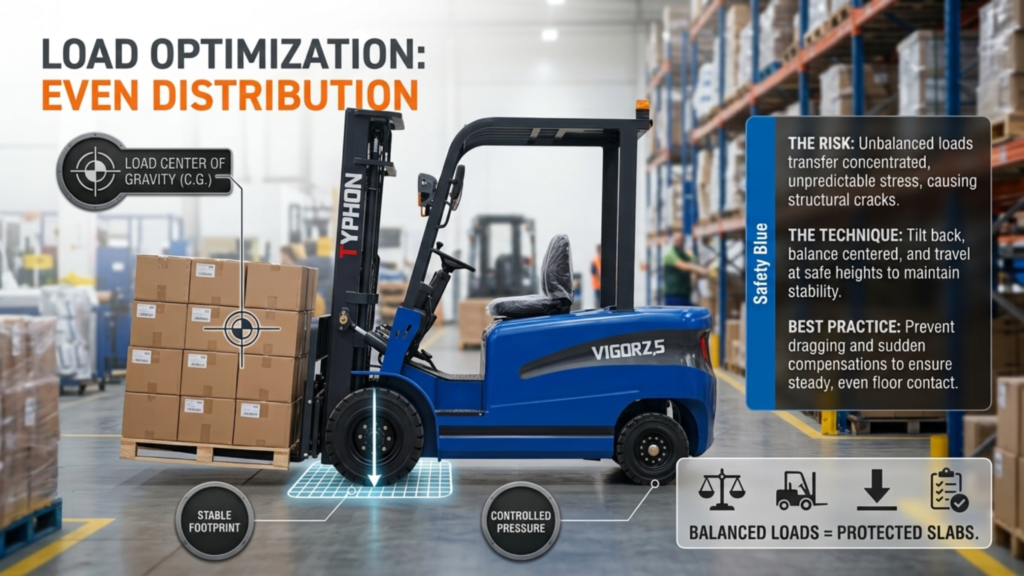
How operators handle loads has a direct and often overlooked effect on floor longevity. A forklift carrying an unbalanced or poorly positioned load distributes its weight unevenly, concentrating stress onto specific points of the floor and forcing the machine into movements that grind and drag against the surface. Training your team to balance loads properly and position the forks correctly keeps weight centered where the machine is designed to carry it, which protects both the floor and the equipment. Proper load handling reduces the structural stress that leads to cracking and prevents the uneven wear patterns that can degrade busy aisles far faster than the rest of the warehouse.
Reinforce these load handling practices with every operator:
- Balance loads evenly on the forks before lifting and transporting them.
- Tilt the forks back slightly during transport to keep weight centered over the drive wheels.
- Keep loads at a safe travel height, neither dragging low nor riding dangerously high.
- Avoid overloading beyond the forklift’s rated capacity, which strains both floor and machine.
The reasoning behind these habits is rooted in weight distribution and stability. When a load is balanced and the forks are tilted back, the weight settles over the drive wheels exactly as the forklift was engineered to handle it. This keeps the machine stable and spreads the force across the floor in a controlled, predictable way. Carrying loads too low risks dragging material across the concrete, while uneven or shifting loads force the forklift to compensate with sudden corrections that transfer unexpected stress into the slab. Those shifts and drags create concentrated forces that lead to structural cracks and accelerated wear in high-traffic lanes. By keeping every load balanced, centered, and properly positioned, operators apply steady, even pressure to the floor, protecting the concrete from the unpredictable forces that cause lasting damage.
Conclusion
Protecting your warehouse flooring is not a single task but an ongoing commitment that touches every part of your operation. The five strategies covered here work together to defend your concrete from the constant demands of forklift traffic. Proper tire management keeps the point of contact gentle, smooth driving habits remove destructive horizontal forces, regular joint maintenance shores up the floor’s weakest points, protective treatments harden the surface against daily wear, and smart load handling keeps weight balanced and controlled. None of these practices require major expense or disruption, yet together they deliver enormous value by extending the life of one of your facility’s largest investments. A well-protected floor means fewer costly repairs, less downtime, a safer working environment, and equipment that operates more efficiently across the board. The key is consistency. Build these habits into your standard operating procedures, train every operator to follow them, and schedule routine inspections so small problems are caught before they spread. Review how your warehouse handles each of these five areas today, identify the one that needs the most attention, and put a plan in place to strengthen it. With a proactive, disciplined approach, your concrete floors will continue to support your operation reliably for many years, giving you the durable, dependable foundation your business depends on.
Expansion and control joints are the weakest points of any concrete floor, and they demand focused attention in any protection strategy. These joints exist for good reason, allowing the slab to expand, contract, and move without cracking randomly across the surface. But because they interrupt the continuous concrete, the edges along each joint are far more vulnerable to impact than the rest of the floor. Every time a loaded forklift wheel rolls across an open or damaged joint, it slams the unsupported edges, gradually breaking them down. Establishing a regular joint inspection and repair routine keeps these critical points intact and prevents small gaps from growing into widespread damage that undermines the entire slab.
Make joint care a scheduled part of your facility maintenance program:
- Inspect joints periodically for cracks, gaps, and missing or worn filler material.
- Repair and replace joint fillers promptly to keep edges supported under traffic.
- Use a semi-rigid filler rated for heavy forklift traffic rather than a soft sealant.
- Address spalling early before crumbling edges spread deeper into the slab.
The consequences of neglected joints escalate quickly. When a joint filler wears away or pulls loose, the edges of the concrete slab are left exposed and unsupported. Under the constant weight of passing equipment, those exposed edges begin to chip and crumble, a process called spalling. Once spalling starts, it feeds on itself. The widening gap subjects the edges to even harder impacts, the damage spreads, and what began as a minor gap turns into a rough, broken channel that jolts every forklift crossing it. Those jolts then stress the equipment and create a rougher ride that damages loads. Proper joint filler restores support to the edges, allowing wheels to roll smoothly across rather than hammering the unprotected concrete. Keeping joints filled and maintained is one of the highest-value protective measures you can take.
Utilize Floor Protection Treatments
Beyond managing equipment and operators, treating the concrete itself adds a powerful layer of defense against daily wear. Bare concrete is porous and relatively soft at the surface, which leaves it open to abrasion, dusting, and gradual breakdown under heavy traffic. Applying the right protective treatments transforms that vulnerable surface into a tougher, denser, more resilient one capable of standing up to constant forklift use. Surface hardeners, densifiers, and quality sealants all work to strengthen the concrete from the top down, closing pores and reinforcing the surface layer. These treatments are a cost-effective investment that pays off in reduced maintenance, longer floor life, and a cleaner working environment throughout the facility.
Consider how each type of treatment contributes to a stronger floor:
- Surface hardeners react with the concrete to create a denser, more abrasion-resistant top layer.
- Densifiers penetrate the slab and fill its pores, reducing dusting and strengthening the surface.
- Protective sealants form a barrier against moisture, chemicals, and surface wear.
- Combined treatments deliver a tougher, dust-proof finish built for heavy-load traffic.
The science behind these products explains why they work so well. Untreated concrete contains countless tiny pores that weaken the surface and allow it to wear away into fine dust under traffic. Densifiers and hardeners chemically fill those pores and bond with the concrete, producing a surface that is significantly harder and more resistant to abrasion. The result is a floor that sheds far less dust, resists gouging and scuffing, and holds up to the repeated stress of forklift wheels. A dust-free surface also improves air quality, protects sensitive inventory, and reduces cleaning costs across the warehouse. By treating your floor proactively rather than waiting for it to break down, you give the concrete the durability it needs to handle years of demanding daily use without constant repair.
Optimize Load Weight and Fork Positioning
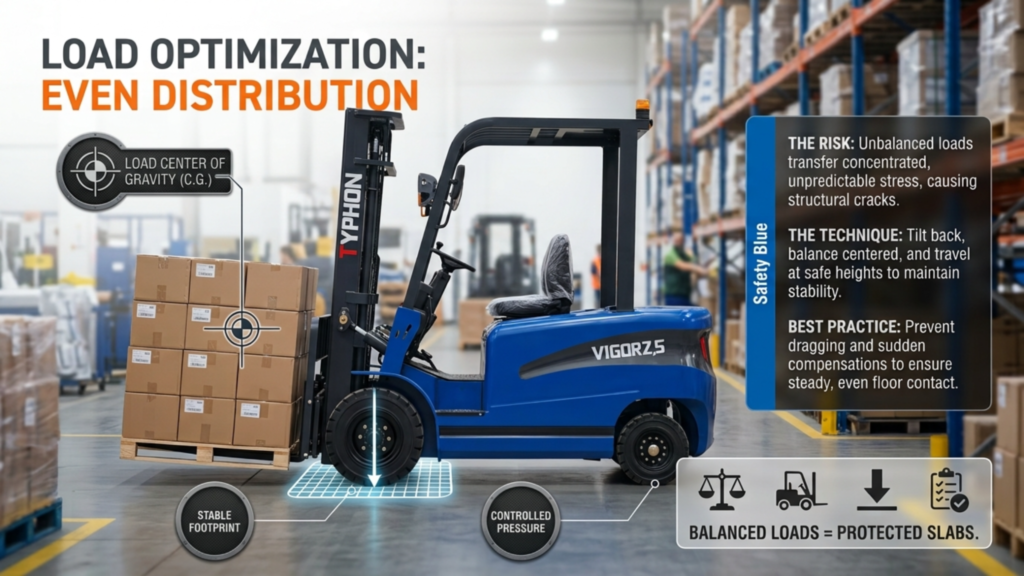
How operators handle loads has a direct and often overlooked effect on floor longevity. A forklift carrying an unbalanced or poorly positioned load distributes its weight unevenly, concentrating stress onto specific points of the floor and forcing the machine into movements that grind and drag against the surface. Training your team to balance loads properly and position the forks correctly keeps weight centered where the machine is designed to carry it, which protects both the floor and the equipment. Proper load handling reduces the structural stress that leads to cracking and prevents the uneven wear patterns that can degrade busy aisles far faster than the rest of the warehouse.
Reinforce these load handling practices with every operator:
- Balance loads evenly on the forks before lifting and transporting them.
- Tilt the forks back slightly during transport to keep weight centered over the drive wheels.
- Keep loads at a safe travel height, neither dragging low nor riding dangerously high.
- Avoid overloading beyond the forklift’s rated capacity, which strains both floor and machine.
The reasoning behind these habits is rooted in weight distribution and stability. When a load is balanced and the forks are tilted back, the weight settles over the drive wheels exactly as the forklift was engineered to handle it. This keeps the machine stable and spreads the force across the floor in a controlled, predictable way. Carrying loads too low risks dragging material across the concrete, while uneven or shifting loads force the forklift to compensate with sudden corrections that transfer unexpected stress into the slab. Those shifts and drags create concentrated forces that lead to structural cracks and accelerated wear in high-traffic lanes. By keeping every load balanced, centered, and properly positioned, operators apply steady, even pressure to the floor, protecting the concrete from the unpredictable forces that cause lasting damage.
Conclusion
Protecting your warehouse flooring is not a single task but an ongoing commitment that touches every part of your operation. The five strategies covered here work together to defend your concrete from the constant demands of forklift traffic. Proper tire management keeps the point of contact gentle, smooth driving habits remove destructive horizontal forces, regular joint maintenance shores up the floor’s weakest points, protective treatments harden the surface against daily wear, and smart load handling keeps weight balanced and controlled. None of these practices require major expense or disruption, yet together they deliver enormous value by extending the life of one of your facility’s largest investments. A well-protected floor means fewer costly repairs, less downtime, a safer working environment, and equipment that operates more efficiently across the board. The key is consistency. Build these habits into your standard operating procedures, train every operator to follow them, and schedule routine inspections so small problems are caught before they spread. Review how your warehouse handles each of these five areas today, identify the one that needs the most attention, and put a plan in place to strengthen it. With a proactive, disciplined approach, your concrete floors will continue to support your operation reliably for many years, giving you the durable, dependable foundation your business depends on.
https://youtu.be/hpkfW0pXN04?si=oeXPvQBEgfwnct84
5 Proven Ways to Prevent Warehouse Flooring Forklift Damage
Warehouse flooring forklift damage is one of the most critical threats to your facility’s capital investment. Warehouse floors often cost tens of thousands of dollars to install, yet these concrete slabs face constant punishment from heavy loads, tight turns, and aggressive maneuvers every hour of every shift. Over time, that relentless traffic takes its toll. Surface cracking, spalling, joint deterioration, and deep structural issues all creep in when a floor is left to fend for itself.
The damage rarely happens overnight, which is exactly why it is so easy to ignore until repair bills arrive and operations grind to a halt. A proactive approach changes that outcome entirely.
By managing the equipment, the operators, and the floor itself with a clear strategy, you can dramatically extend the working life of your concrete. This guide walks through five proven strategies to stop warehouse flooring forklift damage in its tracks. Treat these practices as standard operating procedure rather than occasional fixes, and your floor will reward you with lower maintenance costs and a safer environment.
1. Implement Proper Tire Management to Stop Warehouse Flooring Forklift Damage
Tires are the first and only point of contact between your machinery and the floor, which makes them a critical factor in how well your concrete holds up. The wrong tire, or a neglected one, transfers destructive forces directly into the slab with every pass, accelerating warehouse flooring forklift damage.
Choosing the correct tire type for your environment is one of the simplest yet most effective ways to protect your investment. High-quality, non-marking tires distribute weight evenly and avoid leaving dark scuff lines.
Keep these tire management practices front and center:
- Choose non-marking tires designed specifically for indoor warehouse use.
- Match the tire compound to the surface to prevent uneven pressure points.
- Keep tires free of embedded rocks, metal shards, and grit that grind into the floor.
- Replace worn or damaged tires promptly before flat spots cause structural harm.
A healthy tire spreads the weight across a smooth contact patch. Once a tire develops flat spots, that weight concentrates into intense pressure points that gouge the surface. By replacing them before they degrade, you prevent a surprising amount of warehouse flooring forklift damage.
2. Standardize Smooth Driving Habits
Operator behavior is the single largest factor in how long a warehouse floor lasts. Even the best concrete deteriorates quickly under aggressive driving. The way your team accelerates, brakes, and turns determines whether the floor stays smooth for decades or starts breaking down in a few years.
To mitigate warehouse flooring forklift damage, enforce these driving standards:
- Set and strictly enforce speed limits appropriate for each aisle.
- Require smooth acceleration and braking instead of hard, rapid stops.
- Eliminate sharp, scuffing pivots that grind tires sideways across the concrete.
- Slow down near vulnerable areas like control joints and loading ramps.
When a forklift accelerates hard or whips through a tight turn, it generates immense shearing stress. This force is especially destructive at joint edges. Holding every operator to smooth, controlled driving removes these violent forces from the equation, keeping repair costs down and ensuring compliance with OSHA warehouse safety guidelines.
3. Establish Regular Joint Maintenance
Expansion and control joints are the weakest points of any concrete floor. They allow the slab to expand and contract without cracking randomly, but their edges are highly vulnerable to impact. Every time a loaded wheel rolls across an open joint, it slams the unsupported edges, leading to severe warehouse flooring forklift damage.
Make joint care a scheduled part of your facility maintenance program:
- Inspect joints periodically for cracks, gaps, and missing filler material.
- Repair and replace joint fillers promptly to keep concrete edges supported.
- Use a semi-rigid filler rated for heavy traffic rather than a soft sealant.
- Address minor spalling early before crumbling edges spread deeper into the slab.
When joint filler wears away, the exposed edges chip and crumble (spalling). This widening gap subjects the edges to harder impacts, turning a minor gap into a broken channel that jolts every machine crossing it. Proper joint maintenance is a high-value protective measure for any facility. (For more facility upkeep tips, view our complete warehouse maintenance checklist).
4. Utilize Treatments Against Warehouse Flooring Forklift Damage
Beyond managing equipment and operators, treating the concrete itself adds a powerful layer of defense. Bare concrete is porous and relatively soft at the surface, leaving it open to abrasion and dusting. Applying protective treatments transforms that vulnerable surface into a tougher, denser finish capable of standing up to constant use and resisting warehouse flooring forklift damage.
| Treatment Type | How It Protects the Floor | Ideal Application |
|---|---|---|
| Surface Hardeners | Reacts with concrete to create a dense, abrasion-resistant top layer. | High-traffic aisles and loading zones. |
| Densifiers | Penetrates pores to reduce dusting and strengthen the overall slab. | Entire warehouse floors to improve air quality. |
| Protective Sealants | Forms a topical barrier against moisture, chemicals, and surface wear. | Areas prone to spills or chemical exposure. |
Densifiers and hardeners chemically bond with the concrete, producing a surface that sheds far less dust and resists gouging. Treating your floor proactively gives the concrete the durability it needs to handle years of demanding daily use.
5. Optimize Load Weight and Fork Positioning
How operators handle loads has a direct effect on floor longevity. A machine carrying an unbalanced load distributes its weight unevenly, concentrating stress onto specific points of the floor and forcing movements that grind against the surface.
Training your team to balance loads properly prevents the uneven wear patterns that cause warehouse flooring forklift damage. Reinforce these load handling practices:
- Balance loads evenly on the forks before lifting and transporting them.
- Tilt the forks back slightly to keep weight centered over the drive wheels.
- Keep loads at a safe travel height to avoid dragging material across the concrete.
- Never overload beyond the rated capacity, which strains both the floor and the machine.
When a load is balanced and the forks are tilted back, the weight settles over the drive wheels exactly as engineered. This spreads the force across the floor in a controlled way, protecting the concrete from the unpredictable forces that cause lasting structural cracks.
Conclusion
Preventing warehouse flooring forklift damage is an ongoing commitment that touches every part of your operation. Proper tire management keeps the point of contact gentle, smooth driving habits remove destructive horizontal forces, regular joint maintenance shores up the floor’s weakest points, protective treatments harden the surface, and smart load handling keeps weight balanced.
None of these practices require major expense, yet together they deliver enormous value. Build these habits into your standard operating procedures, train every operator to follow them, and schedule routine inspections. With a proactive, disciplined approach, your concrete floors will continue to support your operation reliably for many years.
Watch this video to learn more about protecting your warehouse environment: https://youtu.be/hpkfW0pXN04?si=oeXPvQBEgfwnct84
5 Proven Ways to Prevent Warehouse Flooring Forklift Damage
Warehouse flooring forklift damage is one of the most critical threats to your facility’s capital investment. Warehouse floors often cost tens of thousands of dollars to install, yet these concrete slabs face constant punishment from heavy loads, tight turns, and aggressive maneuvers every hour of every shift. Over time, that relentless traffic takes its toll, and warehouse flooring forklift damage begins to show. Surface cracking, spalling, joint deterioration, and deep structural issues all creep in when a floor is left to fend for itself.
The damage rarely happens overnight, which is exactly why it is so easy to ignore until repair bills arrive and operations grind to a halt. A proactive approach changes that outcome entirely, stopping warehouse flooring forklift damage before it escalates into a facility-wide crisis.
By managing the equipment, the operators, and the floor itself with a clear strategy, you can dramatically extend the working life of your concrete. This guide walks through five proven strategies to stop warehouse flooring forklift damage in its tracks. Treat these practices as standard operating procedure rather than occasional fixes, and your floor will reward you with lower maintenance costs, effectively eliminating warehouse flooring forklift damage over the long haul.
1. Implement Proper Tire Management to Stop Warehouse Flooring Forklift Damage
Tires are the first and only point of contact between your machinery and the floor, which makes them a critical factor in how well your concrete holds up. The wrong tire, or a neglected one, transfers destructive forces directly into the slab with every pass, rapidly accelerating warehouse flooring forklift damage.
Choosing the correct tire type for your environment is one of the simplest yet most effective ways to protect your investment and prevent warehouse flooring forklift damage. High-quality, non-marking tires distribute weight evenly and avoid leaving dark scuff lines that ruin the surface.
Keep these tire management practices front and center to avoid warehouse flooring forklift damage:
- Choose non-marking tires designed specifically for indoor warehouse use.
- Match the tire compound to the surface to prevent uneven pressure points.
- Keep tires free of embedded rocks, metal shards, and grit that grind into the floor.
- Replace worn or damaged tires promptly before flat spots cause structural harm.
A healthy tire spreads the weight across a smooth contact patch. Once a tire develops flat spots, that weight concentrates into intense pressure points that gouge the surface. By replacing them before they degrade, you prevent a surprising amount of warehouse flooring forklift damage and extend the lifespan of your slab.
2. Standardize Smooth Driving Habits to Mitigate Warehouse Flooring Forklift Damage
http://googleusercontent.com/image_collection/image_retrieval/15649032433665494883_0
Operator behavior is the single largest factor in how long a warehouse floor lasts. Even the best concrete deteriorates quickly under aggressive driving, leading directly to severe warehouse flooring forklift damage. The way your team accelerates, brakes, and turns determines whether the floor stays smooth for decades or starts breaking down in just a few short years.
To mitigate warehouse flooring forklift damage, enforce these driving standards daily:
- Set and strictly enforce speed limits appropriate for each aisle.
- Require smooth acceleration and braking instead of hard, rapid stops.
- Eliminate sharp, scuffing pivots that grind tires sideways across the concrete.
- Slow down near vulnerable areas like control joints and loading ramps.
When a forklift accelerates hard or whips through a tight turn, it generates immense shearing stress. This horizontal force is especially destructive at joint edges. Holding every operator to smooth, controlled driving removes these violent forces from the equation, significantly reducing warehouse flooring forklift damage, keeping repair costs down, and ensuring compliance with OSHA warehouse safety guidelines.
3. Establish Regular Joint Maintenance to Avoid Warehouse Flooring Forklift Damage
Expansion and control joints are the weakest points of any concrete floor. They allow the slab to expand and contract without cracking randomly, but their edges are highly vulnerable to impact. Every time a loaded wheel rolls across an open joint, it slams the unsupported edges, leading to massive warehouse flooring forklift damage.
Make joint care a scheduled part of your facility maintenance program to combat warehouse flooring forklift damage:
- Inspect joints periodically for cracks, gaps, and missing filler material.
- Repair and replace joint fillers promptly to keep concrete edges supported.
- Use a semi-rigid filler rated for heavy traffic rather than a soft sealant.
- Address minor spalling early before crumbling edges spread deeper into the slab.
When joint filler wears away, the exposed edges chip and crumble. This widening gap subjects the edges to harder impacts, turning a minor gap into a broken channel that jolts every machine crossing it. Proper joint maintenance is a high-value protective measure to stop warehouse flooring forklift damage in any busy facility. (For more facility upkeep tips, view our complete warehouse maintenance checklist).
4. Utilize Surface Treatments Against Warehouse Flooring Forklift Damage
Beyond managing equipment and operators, treating the concrete itself adds a powerful layer of defense against warehouse flooring forklift damage. Bare concrete is porous and relatively soft at the surface, leaving it open to heavy abrasion and dusting. Applying protective treatments transforms that vulnerable surface into a tougher, denser finish capable of standing up to constant use and fighting off warehouse flooring forklift damage.
| Treatment Type | How It Protects the Floor | Ideal Application |
| Surface Hardeners | Reacts with concrete to create a dense, abrasion-resistant top layer. | High-traffic aisles and loading zones. |
| Densifiers | Penetrates pores to reduce dusting and strengthen the overall slab. | Entire warehouse floors to improve air quality. |
| Protective Sealants | Forms a topical barrier against moisture, chemicals, and surface wear. | Areas prone to spills or chemical exposure. |
Densifiers and hardeners chemically bond with the concrete, producing a surface that sheds far less dust and resists aggressive gouging. Treating your floor proactively gives the concrete the durability it needs to handle years of demanding daily use, which drastically lowers the risk of warehouse flooring forklift damage.
5. Optimize Load Weight to Reduce Warehouse Flooring Forklift Damage
How operators handle loads has a direct effect on floor longevity. A machine carrying an unbalanced load distributes its weight unevenly, concentrating stress onto specific points of the floor and forcing movements that grind against the surface, thereby accelerating warehouse flooring forklift damage.
Training your team to balance loads properly prevents the uneven wear patterns that cause warehouse flooring forklift damage. Reinforce these load handling practices:
Pro Tip: Balance loads evenly on the forks before lifting and transporting them, and always tilt the forks back slightly to keep weight centered over the drive wheels.
- Keep loads at a safe travel height to avoid dragging material across the concrete.
- Never overload beyond the rated capacity, which strains both the floor and the machine.
When a load is balanced and the forks are tilted back, the weight settles over the drive wheels exactly as engineered. This spreads the force across the floor in a controlled way, protecting the concrete from the unpredictable forces that cause lasting structural cracks and severe warehouse flooring forklift damage.
Conclusion: Winning the Fight Against Warehouse Flooring Forklift Damage
Preventing warehouse flooring forklift damage is an ongoing commitment that touches every part of your operation. Proper tire management keeps the point of contact gentle, smooth driving habits remove destructive horizontal forces, regular joint maintenance shores up the floor’s weakest points, protective treatments harden the surface, and smart load handling keeps weight balanced. All of these combined are your absolute best defense against warehouse flooring forklift damage.
None of these practices require major expense, yet together they deliver enormous value in the fight against warehouse flooring forklift damage. Build these habits into your standard operating procedures, train every operator to follow them, and schedule routine inspections. With a proactive, disciplined approach, you can halt warehouse flooring forklift damage entirely, ensuring your concrete floors continue to support your operation reliably for many years to come.


