
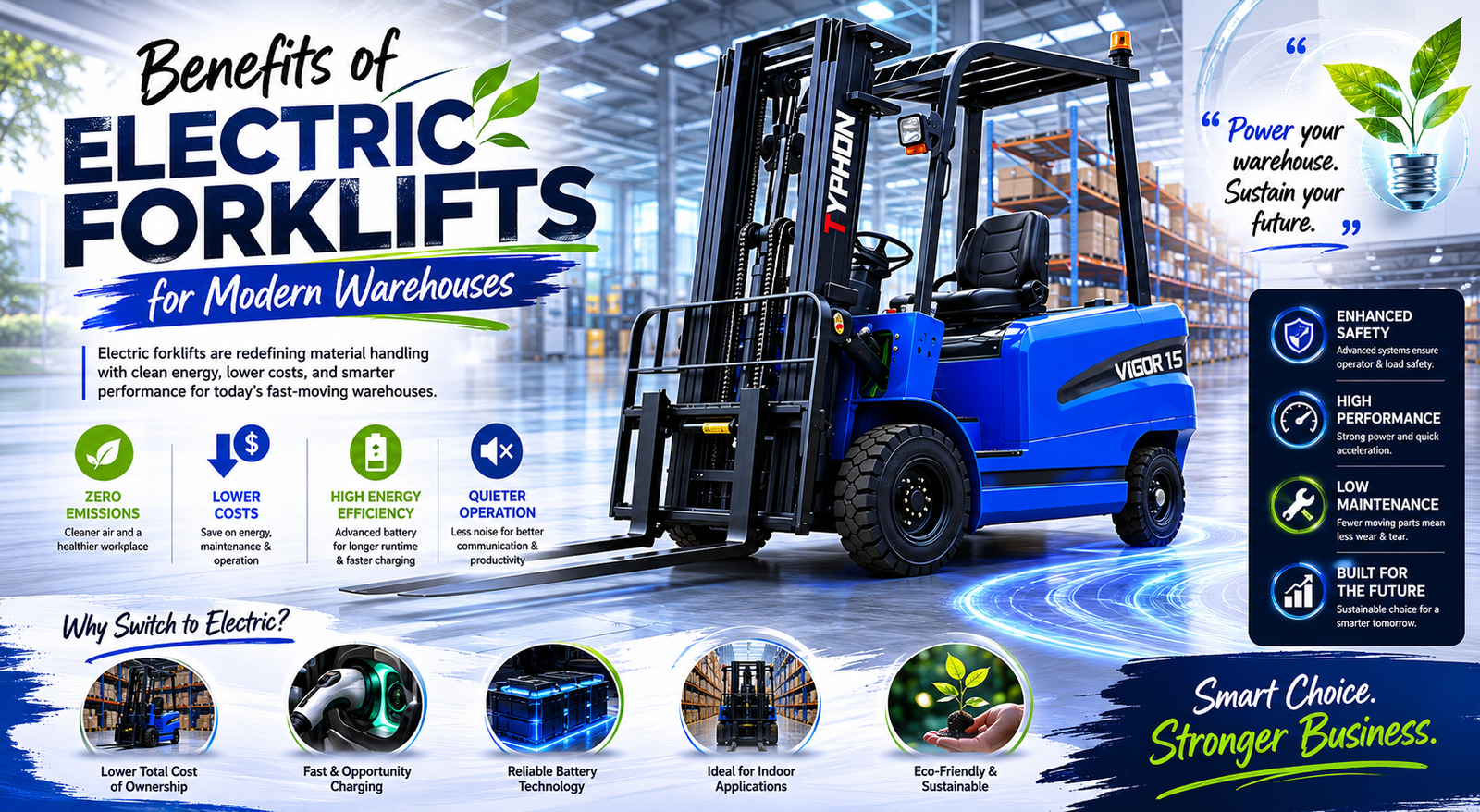
The Top Benefits of Electric Forklifts for Modern Warehouses
Benefits of Electric Forklifts for Modern Warehouses
Modern warehouses need equipment that supports speed, safety, clean operation, and cost control. As facilities handle higher order volumes, tighter delivery windows, and stricter workplace standards, the forklift fleet plays a major role in daily performance.
Electric forklifts have become a strong choice for warehouse managers, logistics teams, and equipment buyers who want reliable material handling without the fuel costs, emissions, and noise of traditional internal combustion equipment. They are well-suited for indoor environments, high-density storage layouts, and operations focused on long-term efficiency.
This guide explains the key benefits of electric forklifts and how they can help modern warehouses operate in a safer, cleaner, and more productive way.
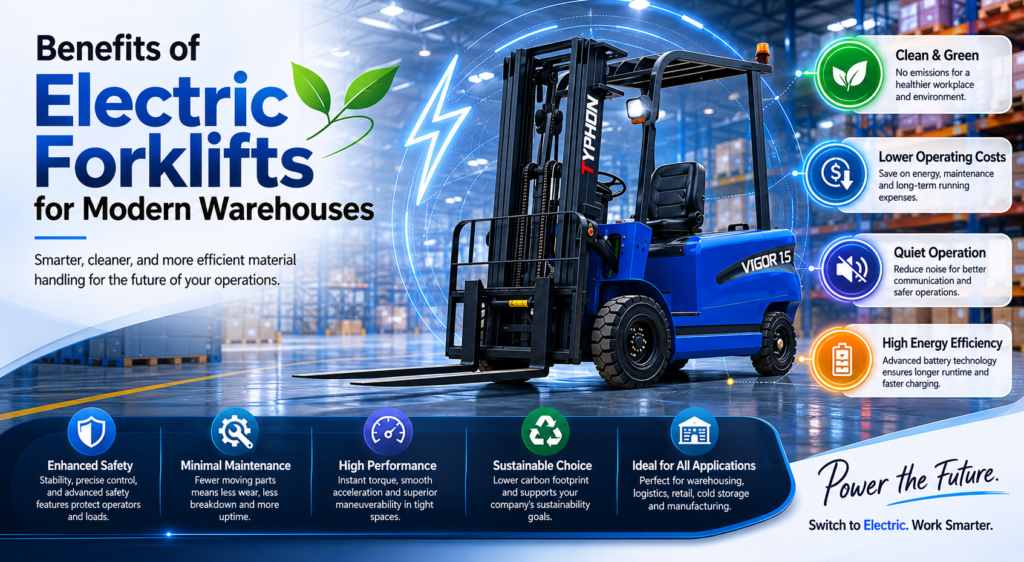
Lower Emissions for Cleaner Operations
One of the biggest advantages of electric forklifts is their clean operation. Unlike diesel or propane forklifts, electric models produce no tailpipe emissions during use.
This matters in warehouses where equipment runs near employees, inventory, loading docks, and enclosed storage areas. Lower emissions help create a healthier work environment and reduce the need for heavy ventilation systems.
Electric forklifts are especially valuable in facilities that handle:
- Food and beverage products
- Pharmaceuticals
- Consumer goods
- Retail inventory
- Cold storage items
- Sensitive packaging materials
Cleaner equipment also supports sustainability goals. Many companies are working to reduce their carbon footprint, and switching to electric forklifts is a practical step toward that goal.
Better Indoor Air Quality
Indoor air quality is a serious concern in busy warehouse environments. Exhaust from fuel-powered equipment can build up in enclosed areas, especially when ventilation is limited.
Electric forklifts help solve this issue by operating without combustion fumes. This can improve the working conditions for operators, pickers, packers, dock workers, and maintenance teams.
Better indoor air quality can also support:
- Improved employee comfort
- Reduced exposure to harmful fumes
- Cleaner inventory storage areas
- Better compliance with workplace safety expectations
- A more professional facility environment
For warehouses that run forklifts throughout the day, this benefit can make a major difference.
Reduced Noise Levels
Warehouses are already noisy places. Conveyors, pallet movement, dock doors, alarms, and equipment traffic all add to the sound level. Fuel-powered forklifts can make this problem worse with engine noise and vibration.
Electric forklifts operate much more quietly. Their motors produce less noise, which helps create a calmer and safer work environment.
Lower noise levels can benefit your operation by:
- Improving communication between workers
- Reducing operator fatigue
- Making warning signals easier to hear
- Supporting safer movement around pedestrians
- Creating a better workplace experience
A quieter forklift fleet does not just improve comfort. It can also improve awareness on the warehouse floor.
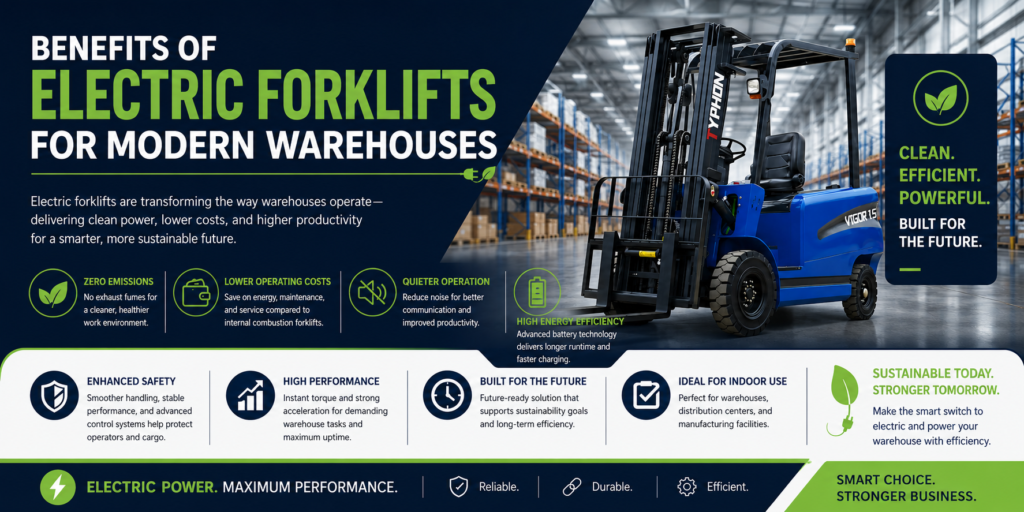
Lower Operating Costs
Electric forklifts often cost more upfront than some fuel-powered models, but they can deliver strong savings over time. Their operating costs are typically lower because electricity is usually less expensive than diesel, gasoline, or propane.
Warehouses can also manage charging schedules to control energy use. For example, charging batteries during off-peak hours may help reduce utility costs in some facilities.
Lower operating costs may come from:
- Reduced fuel spending
- Fewer engine-related maintenance needs
- Less downtime from fuel system issues
- Longer service intervals for certain components
- Lower daily energy costs
When evaluating equipment, buyers should look beyond the purchase price. The real value comes from total cost of ownership over the life of the machine.
Easier Maintenance
Electric forklifts have fewer moving parts than internal combustion models. They do not require engine oil changes, spark plugs, fuel filters, exhaust system repairs, or radiator maintenance in the same way fuel-powered forklifts do.
This can simplify maintenance planning and reduce the number of service tasks your team must manage.
Common maintenance needs still include:
- Battery care
- Tire inspections
- Brake checks
- Hydraulic system inspections
- Mast and chain lubrication
- Safety system checks
- Charger inspections
Even with these requirements, electric forklifts are often easier and less expensive to maintain over time. A simpler maintenance routine can help keep equipment available when your team needs it most.
Strong Energy Efficiency
Electric forklifts are highly efficient because they convert energy into motion with less waste than combustion engines. Many modern models also use regenerative braking, which helps recover energy during slowing or braking and sends it back into the battery system.
This improves runtime and supports more efficient daily operation.
Energy efficiency is especially important in warehouses with:
- Long operating hours
- Repeated loading and unloading cycles
- High travel distances
- Multi-shift schedules
- Frequent stop-and-go movement
A more efficient forklift helps reduce energy waste while keeping productivity high.
Improved Maneuverability in Tight Spaces
Modern warehouses often use narrow aisles, tall racking, and dense storage layouts to make better use of square footage. Electric forklifts are well-suited for these environments because many models are compact, responsive, and easy to control.
Three-wheel electric forklifts, reach trucks, and narrow-aisle models can help operators move safely and efficiently through tight areas.
Improved maneuverability can help with:
- Faster pallet movement
- Better use of warehouse space
- Reduced product damage
- Easier navigation around racks and dock areas
- Safer operation in congested zones
For facilities where every foot of space matters, the right electric forklift can improve both storage capacity and workflow.
Productivity Gains Across Daily Operations
Electric forklifts can support higher productivity in several ways. Their smooth acceleration, responsive controls, and reduced noise make them comfortable and predictable for operators.
Modern electric models also offer strong lifting performance and consistent power delivery. When paired with the right battery system, they can handle demanding warehouse tasks without slowing down the operation.
Productivity benefits may include:
- Faster material movement
- Less time spent refueling
- Reduced maintenance-related downtime
- Better operator comfort during long shifts
- Smooth handling in narrow aisles
- Reliable performance for repetitive tasks
Lithium-ion battery options can further improve productivity because they allow opportunity charging. Operators can charge during breaks, shift changes, or downtime without removing the battery. This can be a major advantage for busy operations.
Better Fit for Indoor Warehouse Use
Electric forklifts are built for indoor performance. Their clean operation, compact designs, quiet motors, and smooth controls make them a practical choice for many warehouse applications.
They are commonly used in:
- Distribution centers
- Manufacturing facilities
- Retail warehouses
- E-commerce fulfillment centers
- Cold storage facilities
- Food-grade warehouses
- Indoor loading dock operations
Because they do not produce exhaust during operation, electric forklifts are easier to integrate into enclosed buildings. They also help maintain a cleaner environment around workers and stored products.
Long-Term Return on Investment
The long-term return on investment for electric forklifts can be strong when the machine is matched to the right application. While the initial purchase price may be higher, the savings over time can make the investment worthwhile.
Key ROI factors include:
- Lower fuel or energy costs
- Reduced maintenance needs
- Longer equipment life with proper care
- Less downtime
- Improved operator productivity
- Better workplace conditions
- Support for sustainability goals
Fleet managers and equipment buyers should calculate the full cost over several years, not just the upfront price. In many warehouse settings, the lower daily operating costs and reduced service needs can help offset the initial investment.
What to Consider Before Switching to Electric Forklifts
Electric forklifts offer many advantages, but buyers should still evaluate their operational needs carefully before investing.
Important questions include:
- How many hours per day will the forklift operate?
- Will the machine run one shift or multiple shifts?
- What load capacities are required?
- What aisle widths and lift heights must the forklift handle?
- Is the facility ready for charging equipment?
- Should you choose lead-acid or lithium-ion batteries?
- How much maintenance support is available in-house?
- What is the expected total cost of ownership?
The right electric forklift should match your workload, facility layout, and long-term business goals. A properly selected machine will deliver better performance, lower costs, and stronger reliability.
Electric Forklifts Support Safer, Cleaner, and More Efficient Warehouses
Electric forklifts offer clear benefits for modern warehouse operations. They help lower emissions, improve indoor air quality, reduce noise, control operating costs, simplify maintenance, and support efficient material handling in tight spaces.
For warehouse managers and operations leaders, the value goes beyond the machine itself. Electric forklifts can help create a better work environment, improve daily productivity, and support long-term operational goals.
Before making your next equipment decision, review your facility layout, shift demands, load requirements, and maintenance needs. With the right electric forklift, your warehouse can move materials more safely, cleanly, and efficiently every day.
The Top Benefits of Electric Forklifts for Modern Warehouses
Modern warehouses need equipment that supports speed, safety, clean operation, and cost control. As facilities handle higher order volumes, tighter delivery windows, and stricter workplace standards, the forklift fleet plays a massive role in daily performance.
Understanding the benefits of electric forklifts has become essential for warehouse managers, logistics teams, and equipment buyers. They provide reliable material handling without the fuel costs, emissions, and noise of traditional internal combustion equipment. Well-suited for indoor environments and high-density storage layouts, electric models are the go-to choice for operations focused on long-term efficiency.
This guide explains why so many facilities are making the switch, and how these machines can help modern warehouses operate in a safer, cleaner, and more productive way.
Why the Benefits of Electric Forklifts Outweigh Traditional Models
Lower Emissions for Cleaner Operations
One of the most obvious benefits of electric forklifts is their clean operation. Unlike diesel or propane forklifts, electric forklifts produce zero tailpipe emissions during use.
This matters in warehouses where equipment runs near employees, inventory, loading docks, and enclosed storage areas. Lower emissions help create a healthier work environment and reduce the need for heavy, expensive ventilation systems. Cleaner equipment is especially valuable in facilities that handle food, pharmaceuticals, and sensitive packaging.
Better Indoor Air Quality
Exhaust from fuel-powered equipment can quickly build up in enclosed areas, especially when ventilation is limited. Electric models solve this issue by operating completely without combustion fumes.
Better indoor air quality supports:
- Improved employee comfort and long-term health
- Reduced exposure to harmful carbon monoxide fumes
- Stricter compliance with OSHA indoor air quality standards
- A cleaner, more professional facility environment
Reduced Noise Levels
Warehouses are already noisy places. Conveyors, pallet movement, dock doors, and heavy traffic all add to the baseline sound level. Fuel-powered machines make this problem worse with constant engine noise. Because their electric motors produce significantly less noise, electric forklifts help create a calmer, safer work environment where warning signals and verbal communication are easier to hear.
Exploring the Cost and Maintenance Benefits of Electric Forklifts
Lower Operating Costs
While electric heavy equipment often costs more upfront, you will quickly see the benefits of electric forklifts when looking at your monthly bills. Electricity is consistently less expensive than diesel, gasoline, or propane.
Warehouses can also manage charging schedules to tightly control energy use, such as charging batteries during off-peak hours to reduce utility costs. Lower operating costs generally come from drastically reduced fuel spending and fewer engine-related breakdowns.
Easier, Streamlined Maintenance
Electric machines feature far fewer moving parts than internal combustion models. They do not require engine oil changes, spark plugs, fuel filters, exhaust system repairs, or radiator maintenance.
This dramatically simplifies maintenance planning and keeps your equipment on the floor. Common maintenance needs are reduced to basic battery care, tire checks, hydraulic system inspections, and mast lubrication.
Performance and Productivity Gains
To maximize the benefits of electric forklifts, facilities should look at how these machines impact daily workflows and storage layouts.
Strong Energy Efficiency
Electric equipment converts energy into motion with far less waste than combustion engines. Many modern models utilize regenerative braking, which recovers energy during slowing or braking and feeds it right back into the battery system. This efficiency is critical in warehouses with long operating hours, multi-shift schedules, and frequent stop-and-go movement.
Improved Maneuverability in Tight Spaces
Modern warehouses utilize narrow aisles, tall racking, and dense storage layouts to maximize square footage. Because many models are highly compact and responsive, electric forklifts are perfectly suited for these tight environments. Three-wheel electric forklifts and reach trucks help operators move safely, resulting in faster pallet movement and better utilization of vertical space.
Productivity Gains Across Daily Operations
Electric forklifts support higher productivity through smooth acceleration, highly responsive controls, and predictable handling. When paired with modern lithium-ion batteries, they can handle demanding warehouse tasks without slowing down. Lithium-ion options even allow for “opportunity charging,” meaning operators can plug in during breaks without removing the battery from the machine.
Conclusion: A Smarter Investment for Modern Facilities
The undeniable benefits of electric forklifts make them a superior choice for modern warehouse operations. They actively lower emissions, improve indoor air quality, reduce noise pollution, control operating costs, and simplify maintenance—all while supporting highly efficient material handling in tight spaces.
Before making your next equipment decision, review your facility layout, shift demands, and load requirements. With the right machine, your warehouse can move materials more safely, cleanly, and profitably every single day. If you need help sizing the right machine for your facility, contact our equipment sales team today!


