
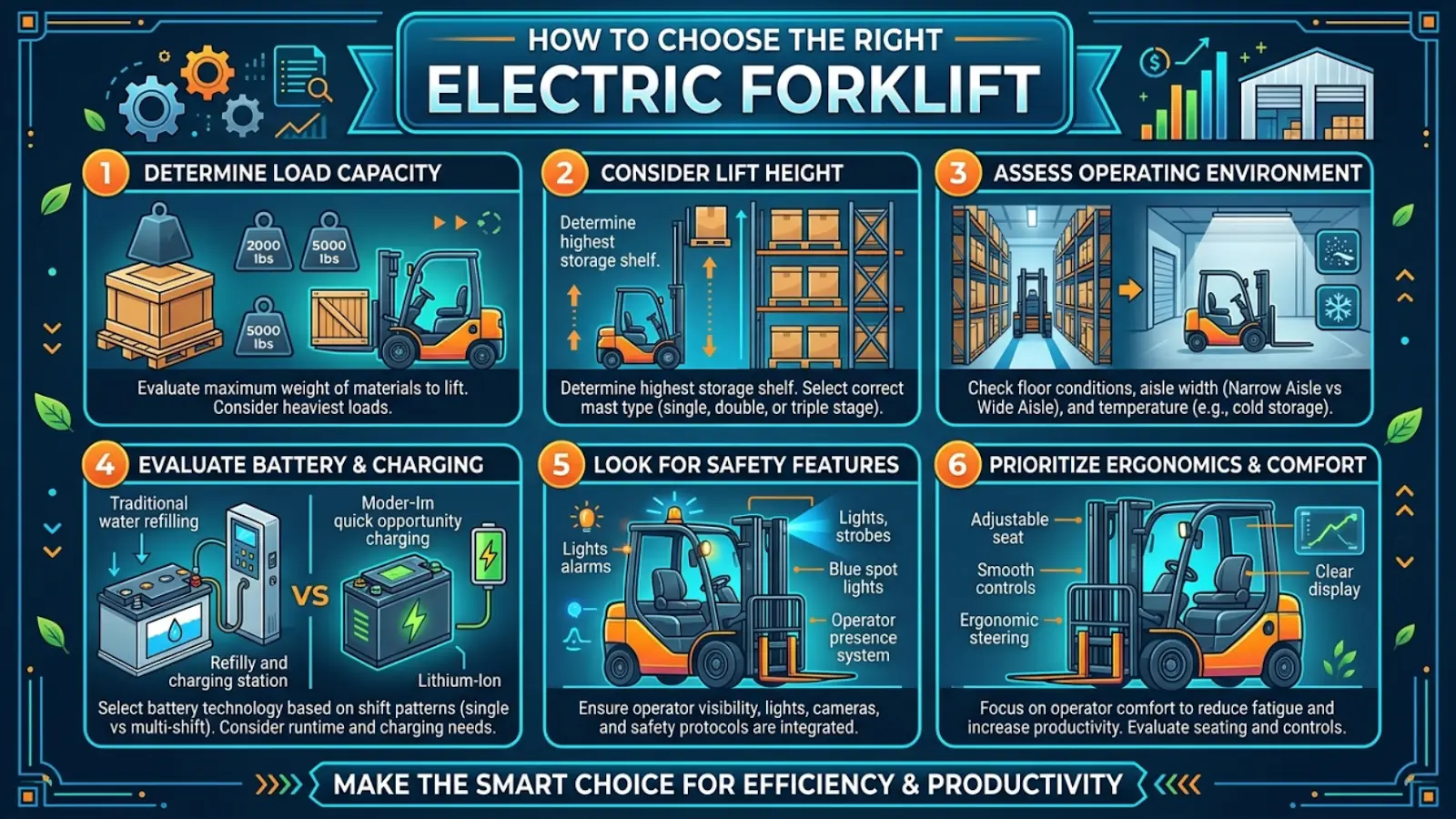
How to Choose the Right Electric Forklift
Adding an electric forklift to your fleet is a big decision that will affect how you run your business. The right tools instantly make your workers more productive, keep them safe, and keep your supply chain running smoothly. Picking the wrong thing can cause frustrating bottlenecks, damaged stock, and wasted money.
To find the right machine, you need to know exactly what your facility needs and how it works. You need to make sure that the equipment fits the weights you lift, the places you go, and the shifts you work. This guide was made to help warehouse managers and business owners choose with complete confidence.
When you’re done reading this post, you’ll know exactly how to figure out how much weight your warehouse can hold, how to look at its layout, and how to pick the best battery technology. Here is a step-by-step guide to getting the best electric forklift for your business.
Step 1: Assess Your Load Capacity Needs
What you need to lift is the basis for your choice. What you need to lift is the basis for your choice. Buying a machine with too little capacity is very dangerous, and buying too much power is a waste of money. Buying a machine with too little capacity is very dangerous, and buying too much power is a waste of money.
Finding the Most WeightFinding the Most Weight
First, look at the heaviest pallets or materials that your team works with. First, look at the heaviest pallets or materials that your team works with. If the heaviest load you usually lift is 4,000 pounds, you might instinctively look for a 2-ton forklift. If the heaviest load you usually lift is 4,000 pounds, you might instinctively look for a 2-ton forklift. But you need to take into account operational variance and attachments. But you need to take into account operational variance and attachments. Adding a side shifter or a special clamp makes the machine less able to lift things. Adding a side shifter or a special clamp makes the machine less able to lift things. Always make sure your side shifter can handle your needs. Always make sure your side shifter can handle your needs. If your maximum load is 4,000 pounds, choosing a forklift with a 5,000-pound (2.5-ton) capacity will make sure it works safely and reliably in all situations. If your maximum load is 4,000 pounds, choosing a forklift with a 5,000-pound (2.5-ton) capacity will make sure it works safely and reliably in all situations. Learning about Load Centers Learning about Load Centers Weight is only part of the story. Weight is only part of the story. The load The distance from the face of the forks to the load’s center of gravity is the center. You should also know this: the load center is the distance from the forks’ face to the load’s center of gravity. You should also know this. The weight ratings for standard forklifts are based on a load center that is 24 inches wide. If you move materials that are longer or shaped in a strange way, the load center moves outward. This move outward greatly lowers the total
Learning about Load Centers
Weight is only part of the story. The load center is the distance from the face of the forks to the load’s center of gravity. You also need to know this. Standard forklifts base their weight ratings on a load center that is 24 inches wide. The load center moves outward if you handle materials that are longer or shaped in a strange way. This outward shift makes it much harder for the forklift to safely lift heavy things. To make sure the forklift you choose can handle that specific weight at an extended load center, measure your largest typical loads.
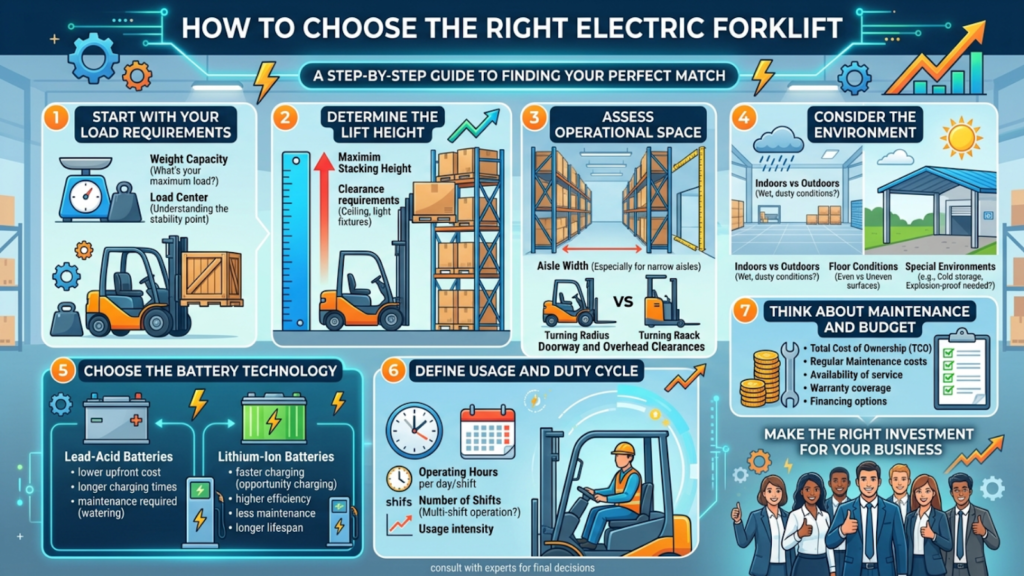
Step 2: Look at the layout of your warehouse
The size and style of the forklift you can use depend on your facility. A machine with a lot of power is useless if it can’t get through your aisles or reach your highest racks.
The width of the aisle and the turning radius
Find the shortest distance between the racks in your warehouse. Standard counterbalance electric forklifts need aisles that are 11 to 13 feet wide to safely turn and load. A standard forklift won’t work if your facility has narrow aisles (8 to 10 feet) or very narrow aisles (under 6 feet). You need special tools like reach trucks or articulated forklifts in these smaller areas. Check the manufacturer’s specifications for the “Right Angle Stack” size. This number tells you exactly how much room the machine needs to turn 90 degrees and put down a pallet.
Racking Height and Lift Requirements
Next, measure the height of your highest racking level. Your forklift must safely reach this height while carrying its maximum rated load. Keep in mind that a forklift’s lifting capacity decreases as the mast extends to its highest points. Ask the manufacturer for the specific capacity rating at your maximum required height. Additionally, check your facility’s clearance limits. Measure the height of your standard doors, dock doors, and any overhead obstructions like sprinkler pipes or hanging lights. Ensure the lowered mast height of your chosen forklift clears these obstacles easily.
Step 3: Select the Right Battery Type
The battery powers your entire operation. Electric forklifts rely heavily on two main battery technologies: lead-acid and lithium-ion. Your choice here impacts your daily maintenance routines, charging schedules, and long-term costs.
Lead-Acid Batteries
Lead-acid batteries represent the traditional, cost-effective power source for electric forklifts. They feature a lower upfront purchase price, making them attractive for businesses with strict initial budgets. However, they require strict maintenance routines. Your team must regularly check and top off the water levels to prevent internal damage. Furthermore, lead-acid batteries require a dedicated, well-ventilated charging room because they release gases during the charging cycle. They also need an 8-hour charge followed by an 8-hour cooling period, meaning you need multiple batteries per truck if you run multi-shift operations.
Lithium-Ion Batteries
Lithium-ion technology transforms how warehouses operate. While the initial investment is higher, these batteries eliminate virtually all daily maintenance tasks. They require zero watering and emit zero gases, removing the need for dedicated charging rooms. The biggest advantage is “opportunity charging.” Your operators can plug the forklift in during a 15-minute coffee break or a 30-minute lunch without damaging the battery’s overall lifespan. This capability allows a single lithium-ion battery to power a forklift through multiple shifts. For fast-paced, high-demand warehouses, lithium-ion technology offers a superior return on investment.
Step 4: Analyze Your Operational Environment
The physical environment where the forklift operates influences the required tire type and protective features.
Indoor vs. Outdoor Use
If your forklift remains strictly indoors on smooth, sealed concrete floors, cushion tires are the clear choice. Cushion tires are made of solid rubber and provide excellent traction on smooth surfaces. They also feature a smaller turning radius, making warehouse navigation much easier. If your operators need to drive outdoors, load trucks in an uneven yard, or navigate cracked pavement, you need pneumatic tires. Pneumatic tires provide the necessary shock absorption and grip to handle rough terrain safely. Some electric forklifts come equipped with solid pneumatic tires, combining the ruggedness of a traditional pneumatic tire with puncture-proof reliability.
Shift Patterns and Usage Hours
Calculate exactly how many hours per day the forklift will run. A machine used for two hours a day to unload occasional deliveries requires a very different setup than a machine running constantly across three shifts. High-usage environments demand heavy-duty motors, advanced cooling systems, and high-capacity lithium-ion batteries. Be honest about your usage patterns with your equipment provider. This transparency ensures they match you with a machine built to handle your specific operational intensity.
Step 5: Consider Ergonomics and Operator Comfort
Your operators sit in these machines for hours at a time. Operator comfort directly impacts warehouse safety, daily productivity, and employee retention.
Evaluate the design of the operator cabin. Look for features like fully adjustable suspension seats that absorb vibrations from the warehouse floor. Ensure the steering column easily adjusts to fit operators of different heights. Visibility is also critical. A poorly designed mast creates blind spots, forcing the operator to lean constantly to see the forks. Choose a forklift that offers a clear, unobstructed view through the mast. Intuitive hydraulic controls, easy-to-read digital displays, and spacious footwells reduce operator fatigue and minimize the risk of costly mistakes.
Step 6: Review Total Cost of Ownership
The sticker price of a new electric forklift is only one part of the financial picture. To make a smart business decision, you must calculate the total cost of ownership over the equipment’s lifespan.
Start by estimating the daily energy costs required to charge the unit. Compare this to the fuel costs of your current propane or diesel models. Next, factor in the maintenance expenses. Electric forklifts feature fewer moving parts than internal combustion engines. They lack spark plugs, transmission fluid, and engine oil, which drastically reduces your preventative maintenance bills. Finally, consider the warranty and aftermarket support. A strong manufacturer warranty and access to local service technicians ensure your fleet stays operational year after year.
Securing Your Ideal Equipment
Choosing the right electric forklift involves careful calculation and honest operational assessments. When you match your capacity needs, warehouse layout, and battery requirements accurately, you set your team up for long-term success.
Take the time to measure your aisles, weigh your heaviest loads, and consult with your lead operators about their daily challenges. We recommend working closely with an established equipment dealer who can conduct a thorough site survey. They will verify your measurements and ensure the machine you select perfectly aligns with your facility. Equip your warehouse with the right electric forklift, and watch your daily productivity soar.
Comments
Add a Review
Your email address will not be published. Required fields are marked*


Cana
it Really good
Arianna3212
https://shorturl.fm/xiZ0e
Mila2565
https://shorturl.fm/dE3by
Kayla1334
https://shorturl.fm/9bZtZ